
A Warre hive is a vertical top bar hive that is simple to build and easy to use. The cost is about one-third to one-fourth the cost of one standard ten frame Langstroth hive. A Warre (pronounced war-ray) hive is simple to manage and maintain. Also known as tiered or supered top bar hives, a vertical top bar hive is such as the Warre hive is friendly to the bees since they are allowed to draw out their own comb. The hive is commonly under supered (nadired) which means the new hive boxes are added to the bottom and not the top of the hive. This promotes the bees natural tendency to build down ensuring a hive environment that is healthier and better suited to their own needs.
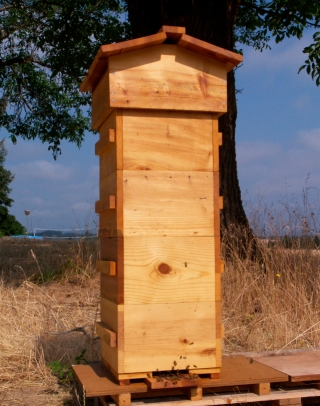
Characteristics of the Warre hive
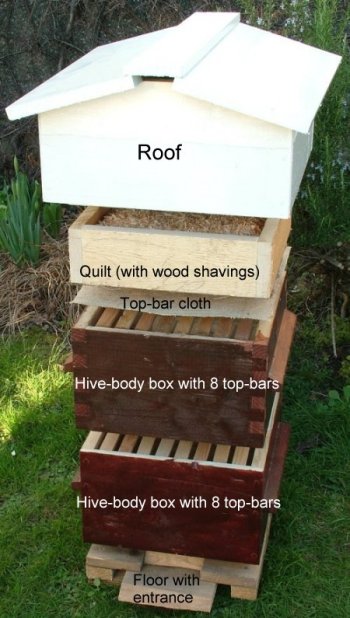
Warre hives have a simple hive box with no frames. The bees draw down their own comb from top bars affixed to each box. The quilt provides a layer of insulation to the hive. It sits under the roof on top of the uppermost box, as you can see below.
Warre hives are easy to build from materials available at your building supply shop. The Warre hive is designed so that it will not take enormous amounts of time out of your busy schedule. In short, the Warre Hive is a good solution for those who are interested in keeping bees simply, naturally and wholesomely without harsh chemicals or medications.
Description of the Warre hive
The Warre Hive comprises tiers of identical boxes fitted with top-bars, but no frames. Its essential design and usage features can be summarised as follows:
Image and description courtesy of the Warre English Portal
- hive-body box internal dimensions 300 x 300 x 210 mm, with projecting handles
- eight 36mm centred 24mm wide top-bars resting in rebates in each box (NO FRAMES)
- wax starter strips under each top bar (NO FOUNDATION)
- flat floor, notched with a 120mm wide entrance, alighting board
- coarse weave cloth covering the top-bars of the top box
- 100 mm high ‘quilt’ boxed with wood, filled with straw, sawdust, wood shavings etc., retained with cloth
- gabled roof containing a ventilated ‘loft’ and separated from the quilt by a mouse-proof board
Here are some more features of the Warre Hive:
- the bees build natural comb in the first (top) box and extend downwards into further boxes
- new boxes are added at the bottom
- one or more boxes of honey are harvested from the top after the main flow
- the bees winter on two boxes of comb containing a minimum of 12 kg stores (France)
- honey is harvested by draining, or by centrifuging combs in baskets
- at the spring visit, the hive is expanded by one or more boxes, containing with starter strips or comb
History of the Warre hive
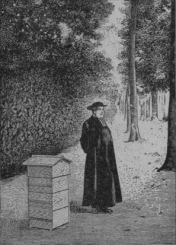
The Warre Hive (also known as the People’s Hive) was developed in France by Emile Warré (1867-1951). Warré developed the People’s Hive after experimenting with over 350 hives of various designs and types. It was his goal to find a hive system that was simple, natural, economical, and bee-friendly. The result was the People’s Hive (Ruche Populaire). He outlined the construction and operation of the hive in his book “Beekeeping for All.” This book is available in English as a free download. If you are interested, English Plans for the Warre Hive are also available.
Warré is not alone in his findings, though. In 1783, a German beekeeper named Johann Ludwig Christ developed a beekeeping system almost identical to that of Warre. And in Japan, many beekeepers still employ a similar system of beekeeping that has been in constant use since the Edo period of Japanese history (A.D.1586 to A.D.1911).
I want a Warre hive…Where Can I Get One?
There are actually a number of places you can get pre-built warre hives these day’s. A couple that come to mind are The Warre Store and Beethinking. If you don’t live in the US then you might want to take a look at Herr Thuminger and Associates. They are located in Vienna, Austria and can deliver ready made hives and hive parts to most of Europe and the UK. If you are a do it yourself kind of person then you can build your own, or download the plans and have a carpenter build a hive for you.
More Info
Check out the Warre English Portal for more info.





I’ve been keeping bees for the last ten years, here in New Brunswick, Canada. My bees are housed in the conventional Langstroth style hives. Over the past several years I’ve watched as the ” Hobbyist ” beekeepers have been infected by diseases I attribute to the pollination beekeeping industry. Varroa is a real problem in our region now, although I’ve relatively little in my apiary. I can’t reconcile myself to having to so heavily medicate my bees against so many ailments when my goal is to produce as ” pure and natural ” a product as possible. For this reason I intend to build a few Warre hives for next summer, and I am very happy to have newly discovered this website. It will be of great value.
I’m looking forward to the Warre Hive step by step construction guide.
Peter
Oxbow Apiary
New Brunswick, Canada
We are new to bees in Nova Scotia and wondered if you would be available to answer some questions for us in regards to the use of the Warre hive?
Thanks,
Orrin
Hello Orrin, there is a lot of information here on the website but if you have a question about something that isn’t already covered I’ll do my best to help.
I agree w/Peter. Nice to find this site, & I’m looking forward to the plans. I would very much like to keep a hive or two of bees in Warre hives starting in 2009–to compare and contrast with the hive I have currently housed in a Kenyan top bar hive.
Hi Charles, wondered if you built the Warre hive and if you did, how do the top barr hive and Warre hive compare? Thanks Yvette
I plan on starting beekeeping this spring with 2 Warre. I read the “Apiculture pour tous” (Beekeeping for All) e-book, and also looked at a few improvements made on the Warre hive, by Marc Gatineau, Freres & Guillaume, Gilles Denis (who uses Warre hives professionally)…
I am glad to find fellow North Americans using the Warre hive.
Andre
Gold Bar, WA, USA.
Andre – Looks like you have been doing a good bit of research. There are many great variations on the basic Warre Hive which we feature here.
Thanks for the link to Gilles Denis. I put it on my Links Page. Good luck with your beekeeping adventure!
Can you help me with something. Perhaps I’ve missed something, but does each “box” have a floor. If so, how do the honeybees get from box-to-box vertically?
Thanks.
James – There is only one floor at the bottom of the hive. All the hive boxes stack on that. That way the bees can climb throughout the hive by slipping in between the top bars. Look at the Warre Hive Installation to see how the hive goes together.
If there is only a floor on the bottom box, what keeps the bees from building a comb from a box above and attaching to the top bars of the box below?
Also since there is no frame in a Warre hive, do the bees try to attach the comb to the walls?
You wrote: “In 1783, another French beekeeper named Johann Ludwig Christ developed a beekeeping system almost identical to that of Warre.”
I think he was from Germany
You wrote: “was developed in France by Émile Warré(1876-1951)”
1876? where did you get that birth year ?
Paul – Thanks for the tip! I have edited the page accordingly.
One of my readers sent me a comment containing what they thought was Warre’s birth year. Thus it should be formatted like this: (1876?-1951) Again thanks for your help!
Actually Nick, Abbé Émile Warré was born in 1867, he lived into his 80s.
Sorry for my dyslexia, I think Paul was trying to correct me too and I blew right over it. It’s been corrected.
I keep colonies of bees in the New Forest ,England. I am concerned at the way we have interfered with the bee. So I am building 3 Warre hives as a test for this years arrival of the inevitable Spring swarms. Very exciting. Thank you for the links to the great plans
Andrew – Thank you for you comment. And you are welcome for the plans.
Andrew
I also live in the New Forest. I started beekeeping this year, 2009. How did you get on with your Warre hives? Did you move any existing colonies from larger hives into the Warres? Or did you just collect swarms?
With kind regards
Chris.
Hi Chris.
I lost 5 put of my 12 colonies last winter, so I decided a change was needed. That’s why I built the Warres. I also use commercials, the 5 I lost were put out as bait hives and all filled within a few months. The Bees seemed less willing to use the Warre’s at first. So I picked up 2 late swarms which are now happily in the Warres.
I have not inspected the hives yet, but froom the amount of bees going in &out and the weight of the hive, hopefully all is well.
Speak again soon
Kindest Regards
Andrew
Hi Andrew,
I’m at Ringwood, 52 BH24 1SH, are you at Bransgore or in Ringwood? Could we get together for a chat about Warres ?
Bob.
Hi,
I’m another New Forest beekeeper building a Warre hive. Chris and Andrew we ought to get together and discuss things and see how the hives progress in 2010. Please contact me.
Bob.
Pingback: Trackback
If one embraces the concept of a top bar, then what is the problem with bottom bars and end bars? As I look at this phenomenon of people embracing the top bar concept, I can see that foundation is a discussable subject, but end bars and bottom bars have no impact on the bees but make the bkpr’s manipulations much easier and possible.
Steve – Thanks for your thoughts Steve! Bottom and end bars create a lot of empty space in the beehive. In a top bar hive the comb is built right up to the sides of the beehive. In a frame beehive, there is quite a bit of empty space caused by the extra wood surrounding the comb. This empty space must be heated by the bees, resulting in less efficiency than if that empty space was eliminated.
Also, there is the whole concept of “manipulations.” Do we really need to manipulate the beehive? Is it healthy to open the hive and move the comb around? Beehives in the wild survive without our manipulations. The concept of natural beekeeping focuses on non-manipulation and non-intrusion. Top bar hives are a good fit for this overall approach to beekeeping.
Nick, the point of the langstroth hive initially was to provide a system where honey could be produced on a larger, more economical scale. With side and end bars, the honey can be extracted with minimal time and effort and the comb returned to be reused by the bees for honey or brood, effectively cutting down the amount of time the bees require to produce replacement comb. With top bar and the warre, this is not viable as the comb is attached to the inside of the hive. The manipulation of the hive comes in handy for hive management, pest and disease control, observing egg production and laying patterns, queen replacement, etc. Supers also allow for a lighter handling weight. The Warre and top bar do not lend themselves to detailed inspection. Don’t get me wrong, these hives are great for the home or hobby beekeeper, especially if they need comb for making candles, lip balm, or comb honey, but they are nearly useless for commercial honey production, besides being more expensive for the hive components overall.
Thanks for the comments Jake. I think the lang hive is a great idea in theory and your right it’s the only way to go for a commercial beek to keep his business profitable. Its the backyard beekeeping where the TBH and the Warre really shine. Letting bees be bees and doing as they please 🙂
I disagree with the idea that a warre hive cannot be used commercially there are a few examples of a commercial model, this guy is using warre hives in Australia. malfroysgold.com.au, plus Émile Warré kept a lot of different hive types himself.
And there is no reason why one can not use frames in a warre without foundation, I know there is a group in LA promoting foundation-less beekeeping. backwardsbeekeepers.com. I also do not see how the proses of uncapping then centrifuging comb is faster then simply crushing and straining.
I guess I just don’t like the idea that the only way a commercial farmer can stay afloat is to use chemicals for everything in a totally unsustainable manner, it wont be long before those practises will not work.
Hi Sam, Thanks for your comments. Using a Warre for commercial purposes is is not impossible, it’s impractical. The cost of wax in regards to honey production is too high IMHO. Even the use of full foundationless frames doesn’t offset this. I did check the links and the guy in Australia is using lots of lang hives too, probably for honey production.
I don’t like the idea that some commercial beeks use so many chemicals either, especially when they don’t have to.
Thank you so much for this website! I am new to beekeeping and just completed building three Warre hives –they are very beautiful! I live on the western slope of the Tetons in Idaho and am hoping this will be a good hive for our harsh climate. Speaking of harsh climates, I have a few questions for you. Our bees are due to arrive tomorrow evening. Yet it is snowing heavily outside :(! We have been struggling with what to do with our new package of bees. Our choices are to 1) go ahead and install the package into their homes outside 2) install them in their hives but keep them in our sunroom/greenhouse (~50 F at night). Do you have any recommendations? I have decided to feed them dry table sugar (or Fondant if I can get it) and also include sugar syrup to cover all bases…. really this is a rude awakening to the learning process, so any advice is greatly appreciated!
Thanks!
Kirsten – Installing the bees and then keeping them in the greenhouse sounds like your best bet. You will need to move the bees eventually. Move the hive at night when the bees are all inside the hive. Then, keep the doors and windows of the greenhouse tightly shut to prevent the bees going back to the old hive location.
Ideally, you will want to move the beehive quite a distance away from the greenhouse when the time comes to do the move.
Hi there from North Yorkshire in the UK.
My kids and I are starting to keep bees this year, with a donated hive from Freecycle, some internet-downloaded factsheets, a very helpful neighbour, and (hopefully) lots of luck.
My neighbour suggested that we looked at top bar hives, and the Abbe Warre hive in particular, as a more sustainable way to keep bees. We have just printed off your plans this afternoon, and my son, daughter and I will start building our first Warre hive this weekend.
THank you so much, not just for the plans, and the construction tips, but for the helpful advice and links.
Kind regards
The YOUNG family
Richmond, North Yorkshire
Mandie – Thanks for your kind words! Sounds like you all are really getting into the spirit of Natural Beekeeping. I wish you good luck for your first year of beekeeping.
Thanks so much for your reply Nick! We ended up hiving them in the enclosed room and then moved them outside a few days later when the weather was a bit warmer. It is still cold at night (30’s and even high 20’s F at night) but warm 55-60 F in the daytime. I fed them with bakers sugar on the top bars for a week or so and now am feeding them with yard feeders (upside down jars outside of hive) of sugar syrup. They are now returning covered in pollen and all seems well. As it gets warmer I will wean them off of the syrup. I do not like the bottom feeder (we built from the plans) because it seems to extend the bottom box which allows combs to be drawn out deeper, and if you don’t watch it then when you go to put another box underneath, the combs are too long. This happened to me and I accidentally broke a brood comb. Now their comb pattern seems to be off so I am wondering if I should remove the comb that I broke and left in the hive. Although I have not tried it yet, I will think about the top feeder in the future, although hopefully I will not have to worry as next year they will have their own stores and not be a new package. Has anyone else used the bottom feeder and have similar issues?
Thanks so much for your website! It is daunting to be new to beekeeping, and more so to have a hive that not many other beekeepers out there are using. Thanks for providing a site for us all!
-Kirsten
Kirsten – Congratulations on your new beehive! It sounds like your queen is doing well and hopefully your new baby bees will be hatching soon. Thanks for your kind words. I am glad you enjoy the site.
Don’t worry about the broken comb. Just leave it and let the bees take care of it. They may remove it, or incorporate it into the rest of the comb structure. I had someone else tell me that their beehive built some comb into the bottom feeder too. So, I guess the trick is check the feeder every couple of days to make sure the bees are not building comb into the trough.
I have used the bottom feeder on two Warre hives and had the exact same problem as you did. Some combs in the bottom box were too long and broke when I added a new box
Hi, Nick! Your site has been the most inspirational of anything I have explored these days. I finally got my bees three days ago. Unfortunately, I ordered a Langstroth hive at the same time as the bees in January right before I ran across your site. So, as much as I’m excited about my bees, I’m a little bummed about all the drawbacks of the Lang. The beekeeper who sold me the nuc of bees and equipment said that I should feed my bees sugar syrup until the middle of the summer and pollen patties for the rest of the year until Christmas. Does that sound right to you? I notice that you recommend feeding them honey, but how do I know that it’s not contaminated with foulbrood or something else? Anyway, I gave them the sugar syrup, but they seem to be all too happy to stay inside the hive gorgeing on the syrup than in foraging when I still see black locust and white clover blooming. Should I take away the syrup? I don’t feel comfortable feeding them sugar when it’s so devoid of nutrients.
Deborah – I think your beekeeper friend was drinking a little too much mead. 🙂 You can remove the sugar syrup. You don’t need to feed sugar during the summer. As you can see, your bees will ignore it. They are not dumb; they know when there is better food to be had. As to pollen patties in fall? Do plants produce pollen in the fall? No. So, feeding pollen patties up to Christmas is definitely “out of season” for the bees. It is best to let the beehive live it’s life season by season. Each season affects the beehive in different ways, and each season is important. Strive to maintain the rhythm of the cycle of the year.
“Do plants produce pollen in the fall? No.”
Actually, there are several autumn growing plants that do produce pollen as long as the temperatures and weather allow. Perhaps not as many as in summer, but they are out there.
I also must chime in about your statement about plants not producing pollen in the fall, for two reasons. One the pollen patties are to supplement a first year hive in case they didn’t collect enough to overwinter with (same reason to feed bees in winter if they haven’t enough honey stored) – remember, the bees feed though the winter when temperatures allow, that’s why they store the pollen. Secondly, there are numerous plants that flower and produce nectar and pollen right up until the first freeze kills them or makes them go dormant, and some plants, like camellia and panzies, flower in the winter, and bees will frequent these flowers on warm winter days to collect pollen. In the south, it’s less of a problem as we have pollen producing plants throughout the year.
I am curious and interested with the bar top hives. I have looked into setting up several unique types of top bar hives, but I always come down to the same questions. Frame manipulation is made much more difficult with the brace comb being drawn out clear to the sides of the hive. I think it is important as beekeepers to establish good beekeeping practices. Keeping track of the hives queen, observing the brood pattern, making sure of adequate honey and pollen stores, observing the amount of drone comb, requeening when needed. All these things are part of beekeeping rather than “bee-having” for lack of a better term, and I am curious as to how easily these things can be accomplished using the warre type hive?
Rob – Thanks for your question! To answer your question I am writing another blog post. Thanks for your inspiration!
Thanks Nick, I am looking forward to the blog post. Thanks too, for the website, a lot of time has gone into this and I appreciate it.
Rob – Thank you Rob for your kind words!
Just wondering if you had any feedback from beeks in the south or southwest on how the Warre handles the heat. Has anyone reported comb failure in one?
Hello Nick,
Thank you for posting info on the Warre hive.
I started beekeeping this spring, read about top bar hives, Gunther Hauk, Rudolf Steiner, and decided to build my own hives. I have copied the
one-room “Golden Hive” design I found at the Melissa Garden site and have 2 of these hives going, and also another top bar hive I purchased at
Beekind in Sebastopol, CA. I have windows in all my hives so I can watch my bees and see how they draw comb. I also captured a swarm in a
June that is flourishing. I’ve read that when bees are allowed to draw their own comb, and control the size of the cells, there are less Varroa mites, which is the case with my hives. I am building a 4th hive and this one will follow the Warre design,
but I wanted it to be a “hybrid” of sorts so I can either put on Langstroth frames one way or top bars the other way. This way I can combine a nuc
or other combinations with others. (I know several beeks that use Langstroth hives, but only use starter strips) I am making a screened bottom and will have an inspection board below that. Photos available. My question is, if you start with a broodbox and add another box below, how do you harvest honey from the top?
Hello Philip,
I’ve been looking at the one-room “Golden Hive”, and I would like to buy or make a couple of these. Can you tell me where I can buy the “Golden Hive” or where I can get plans for the “Golden Hive”? Or can you make and ship unassembled. Please send photos of your Golden hive. My email is: santiagosabejas@yahoo.com. Thank you, and I hope you receive this post.
Anyone else who may read this post, and has any info on purchasing a “Golden-Hive” or has plans may also feel free to email me. Thank you and everyone have a blessed holiday!
Santiago Wallace
Hi;
I’m in BC but will b moving to NB in a couple years. Once there we have gardening plans, etc & I was extremly interested in starting 1 or 2 hives.
Sustained hives sound like the ideal situation for me AND the bees. Just my speed!*L*
I was wondering about good starter tips & knowing anyone in lower NB that has an apiary; but, also, how the honey would b potentially harvested in a top feeder.
I was at a local apiary’s tour & they, as a comp., don’t use the Warre method. If u harvest from the top, is there then no more larva there,etc & is then “just storage” because the hive is on the “bottom” & is continuing to move on down as they build?
Too, what is the best method for having/building a viewing window? Any links I’ve seen so far have dumped me at french sites &b I get lost. ( the french isn’t so good anymore after 15 years out west…. :S
Can you give us the dimensions etc for the one room hive you built? Thanks.
Hi Ben, you might be interested in this set of posts: Construction Guide
Nick,
I just read your post. I posted Philip above regarding the one room “Golden Hive”. I too would like to know the demensions for the Golden Hive. I followed link you posted for Ben: “Construction Guide” and could not find anything regarding the “Golden Hive”. Could you point me in the right direction. Do you know the dimensions of the one room hive “Golden Hive”? You can post here or email me at santiagosabejas@yahoo.com. Thank you very much.
Santiago Wallace
Wallace Family Apiary
Vicki,
This is my method for creating a viewing window:
chose a side of the hive that is at the side or opposite of the entrance, and center its dimensions. Say 4″x12″. Next you will need a drill, jigsaw and router. Purchase a piece of plexiglass that is 4″x 12″ (or whatever size you want). Measure a rectangle that is 3/4″ smaller than your glass, 3-1/4″ x 11-1/4″, and cut out this hole using the drill at the corners to start your jigsaw cut. Next, you will router out a 3/8″ wide lip by 1/8″ deep lip on the inside. This is where the glass lays.
I use a silicone sealer and six tiny brass screws to make sure it’s secure. On the outside, you’ll need to make a window cover, 4″ x 12″, with a 3/8″ x 3/8″ routered edge that will fit into the “porthole”.
You can make supports or attach hinges to hold the bottom, and create a simple latch at the top.
Pingback: What Should We Build? | Chiot's Run
hi,Nick
i have build Warre hives and i am very happy whit it .For now i made 8 and will transfer all my 10 langstroth into Warre . I will come again and again to your site
Eric
ste Julienne Qc Canada
Nick,
I built one of your hives hoping to catch a swarm this summer. A friend called with a hollow tree that they wanted cut down but it had a hive of honeybees in it. I was able to get the bees into my new Warre hive along with some of their honey and brood. I am very excited about my first beekeeping experiences. I do have a few questions though. It is mid August and although we were able to get some honey and brood it didn’t fill up the box. Should I wait a few weeks and check again to see if they need another box on the hive or just put one on to begin with? I want to make sure that they’ll have enough honey for the winter but I feel like they’re getting a late start because we moved them so late in the season. Also, should I be feeding them?
Thank you so much for all the wonderful information and the time you put into this awesome web site!!!
Annie
Eugene, OR
Hello Nick
Thanks for your site. I started beekeeping this year, and built a National hive. I am pretty new to all this but the more I read about beekeeping the more I really like the idea of the Warre approach. But how do I move my bees from the National into a Warre? What about all their brood and stores?
Any advice would be appreciated.
With kind regards
Chris.
Hi Chris,
I’m in Ringwood, can we get together for a chat re Warres ? I’m at 52 BH24 1SH
Bob.
Hi,
I just come across this site and am interested in using Warre hives. I also keep my bees in the New Forest, near Minstead. If there was any chance to get advice or chat about about starting warre hives I would be very grateful.
Cheers
Pete
Hi Pete,
I started my Warre last spring, putting the bees in by shook swarm from one of my Nationals but now its just wintered down. Email me and we could meet up for a chat about Warre’s and bees. Have you built your hive yet ? I’m on the other side of the Forest at Ringwood.
Bob.
Hello Nick,
I’m very interested in the warre hive, but have a few concerns if you or anyone can comment.
Is it possible to lift several boxes without seperating them to place one underneath.
If one can remove a box of honey from the top can this be done easily. I can imagine pulling a chese wire through the join.
Do we still treat for Varroa in any way and would an open mesh floor go against the warre principle.
And above all what happens when the Bee inspector calls and wants to remove comb.
Regards Jim.
Jim, Warré was in France when he did all these studies. You can well imagine that someone keeping bees elsewhere could have vastly different weather & issues. Some folks do add a screened bottom. you could start w/o one, and build it to use if & when you want to try that. often beeks will not use these in the winter, anyway.
There is a lift that is like a cross between a hand-truck and a forklift that can be made, or a friend can help you lift the boxes. Each will be about 50 lbs/25 Kg, if full.
The “traditional” nailed in top bar, need not be nailed in. You can resort to a variety of simple measures. Then they are like any Top Bar hive, but with less weight of comb to break off the Top Bar than many large top bar hives have.
To add to Bill’s comment, I removed the bottom bars from my frames and used starter strips this year. The bees finished drawing out the comb. This setup is a Guillarme (sp) frame, which allows the frame to be removed without breaking comb attached to the walls, as you still have sidebars in place.
Personally I wouldn’t allow an inspector to handle my frames; I’d be happy to that myself; they’re *my* girls, afterall. 🙂
On the screen bottom, you can also make a solid insert for it as well; this is a good way to check your hive health without opening stuff up, so think about making the bottom with a drawer or slideout type option for use when doing a mite count.
Pingback: Beehives - Page 2 - Woodwork Forums
Pingback: Happy New Year 2010 « Imladris Gardens
Pingback: Warre Hive Construction « Bay Branch Farm
how do you prevent mice from entering the hive??
The problem is only from late autumn and through the winter when the bees aren’t up to par defending the entrance. I will make up a mouse guard from tin plate (used bean can) cut entrances of 9 mm width. This is smaller than a mouse skull so if it can’t get its head through – the rest wont follow. My Warre is complete – just waiting for the weather to add the girls.
I use 3/8″ hardware cloth for a mouse guard. If you can’t find a bean can, or don’t have tin snips, or can’t find 3/8″ hardware cloth, an aluminum can will work; you can cut it with either a knife or heavier kitchen scissors.
Someone earlier was asking for a Warre builder in the US. Try here. seems quality gear.
http://sonomaguy. org/Bee_Stuff/ mygirls.html
Bob G.
Another Warre Builder in the US is in the Midwest. Very informative with his products and prompt to return e-mails about orders and help.
Website is BloominBZ.com
Folks, if you are looking for real quality built Warre hives and accessories, manufactured by a real company right here in the U.S.A., you must check out thewarrestore.com. We have everything that you could want and we ship for free to the contiguous 48.
I read with interest Annie from Eugene. I have a rather large log on saw horses with a very active hive in it. I am interested in how to get the bees out of it and into a hive . ( The honey I can get out with a chain saw.) I have already captured two swarms from it but would like to get rid of the log altogether.
Exactly how does one transfer a swarm or package into a warre? Dump them into the top hive box, remove some of the bars or what? Gerry
Gerry, with package bees, remove a couple frames from the super first. Give the bees a light spritz of warm water to minimize flying and to refresh them after shipping. Remove the feed can, then the queen in her cage. If there is a small cork, you’ll want a marshmallow handy. Give her a spray so she doesn’t fly. Remove the cork and VERY quickly replace it with marshmallow. Reason is the queen is grafted, so if released early, the bees might kill her. Rest the cage on a topbar, facing down between frames. In a few days, they will recognize her phermone and chew out the marshmallow. Check to make sure she’s out after 3 days. If not, open the cage and WATCH her walk out ONTO the comb. Check back in a week and look for brood.
Swarms are a bit tricky, as it depends on where you find them. Could be at chest level, or up in a tree or house.
I try and keep a bait hive handy with a frame or two of comb, so there is a nest scent present. If quick n dirty, a peat pot from the nursery screwed to a board to close the top is good; cork or bathtub plug for drain hole. I have a couple queen phermone ampules to put in the hive to make it attractive to set nearby. If in a tree, have pruning shears handy. Trim what you can out of the way; gently brush the bees down into your box/container. If they’ve only recently swarmed, they’re fairly gentle. You MUST make sure you have the queen, or they won’t stay put. If possible, leave your stuff there, so the scout bees will return by evening. Seal them up and take them to your apiary.
As mentioned, a lot of it depends on the circumstance, but that’s just a basic description on how it’s done. Use some sense; be flexible on the fly. Understanding bee behaviour is a big help.
Recommend: ‘At the Hive Entrance’ by Storch from BetterBee’s website. >cheers<
Question from Gerry Mathews, How to load bees into a Warre hive? Loading the Warre hive is very simple. Tape some paper over the top of the bars, then tip the box over and Poor the bees in. Place the bottom board on and tip the whole thing over.
A. Frederiksen
Remember, the bars on the Warre hive will not fall out because they are nailed in.
My top bars aren’t nailed in. Like a few other Warre-ors I know, I put a small kerf notch in the end of the bars, and have brads nailed onto the rebate to maintain spacing.
This allows the hive to be inspected, which is required in some states/countries.
If you’re looking for another supplier of assembled and unassembled Warre hives, as well as horizontal top bar hives, feel free to take a look at our site or send us an e-mail: http://www.beethinking.com
Cheers,
Matt
This is my first year of bee keeping and I am having great sucess with 2 Warre Hives. Both are on there 4 box and it is only mid summer.
But, I have not found anything about harvesting the honey in a Warre Hive. Does one have a link or ideas about Harvesting the Honey.
Here you go Willie; scroll down.
http://warre.biobees.com/methods.htm
I usually buy food grade buckets or the like from a local restaurant equipment supplier to save on freight from the ’48.
I usually put up my honey as either chunk or comb honey. A comb cutter for the latter can be purchased through someone like Brushy Mountain Bee.
Regardless, count on making a mess, LOL! I buy the foil oven bottom liners to use for my cutting, and feed the leftover mess back to the bees; they’ll clean it all up.
So do you try to get the bees out of the upper box before you take it apart or just have at it.
Will, this is one of the few times you would use a smoker to drive the bees downward into the lower supers.
Your smoker should be up and cookin’ before you start. DO TAKE CARE not to set your smoker down where you would knock it over or cause a grass fire. I set mine in a milk crate with an old pie tin in the bottom. Cheap insurance.
Ideally, you should have a wire cutter or guitar string to pull between the super and the one beneath it to break the comb loose from the topbars below. This keeps you from tearing up comb. Do this slowly; the bees will move out of the way. If you can’t do this, take your hive tool and lift/offset the super slightly to break the super/comb loose.
Remove the quilt/roof, topbar cloth, then smoke the bees across the top edge of the super to start driving them downward.
Once it appears you have most of the bees driven down, remove the super. Cover it up with another topbar cloth, or have some cardboard handy to cover the super to minimize robbing. Get the other topbar cloth back on the hive, and close it up.
You can set your wet box back on the bees for them to clean up and rebuild comb; just make sure you leave a nice strip on the topbars for them.
There are lots of beek videos out on YouTube to check out too. The main thing is that you need to know EXACTLY what to do with the super once you’ve removed it from the hive, so choreograph your tasking. ;-))
Margie;
Thanks you so much for taking the time to help me out.
I will look on U-Tube.
Normally I put new boxes on the bottom, but you feel we should put the wet box back on top?
Willie, I nadir (Latin, lowest point) also. If you’re in one of the ’48, you guys still might have a ways to go with your foraging window for the bees. They will be putting their stores overhead for the winter; that’s just what bees do. If there is still another full box of food below what you’re pulling off of there, you might consider putting the wet box back on the bottom.
Either way, the girls will clean things up; whether its set back on, or left out for them to clean up. It depends on what you’ve got for extra equipment; not everyone has extra, so they have to quick turn the supers for harvest, and get them back onto the hives.
If letting them clean out a wet super, make sure it’s at least 20-30 ft away, so it doesn’t induce robbing activity. Takes them a few hours if the weather is good. 😉
Margie:
Thanks again for all the help.
Warre hives can be purchased from http://www.thewarrestore.com/
There is a host of valuable info on this site
We are having a talk about the Warre hive at our local UK beekeeping meeting this week. I did not know of the presence of this hive. I have tried smith,, national and long hive but have settled for national hives in my apiary. It is interesting to read of your experience and problems when using this design of hive and I will certainly try one out next year.
Hi Terri,
Where abouts is the meeting for the Warre talk ? I have been to several by John Haverson, he has a good coverage of the subject of Warre’s and top bar hives. Are you local to Hampshire? Cheers,
Bob.
Hi there,
Thanks for the great, informative website. I have a couple years’ experience working at a commercial apiary, and am very interested in starting my own small, commercial Warre apiary sometime in the future. I’ve been doing a lot of searching for information, and I have some questions you may be able to answer or point me in the right direction:
1)Are there extractors out there for extracting from Warre hives? I know Warre used frame cages for the fixed comb in an extractor, but haven’t been able to find any further details. There are some commercial Warre beekeepers out there, still can’t find info. It seems that crush & strain, or pressing, methods would be simply too slow and labour-intensive for a commercial operation (I’m thinking 300-400 hives).
2) In the harsh winter climate of the Canadian prairies, what would I do about fall/overwinter feeding? There is a main late-summer flow of canola here, which very quickly granulates and turns hard as cement, and the bees can’t use it in winter, they would starve. But, ideally, I would like to stay away from feeding sugars, especially HFCS. Are there any alternatives? Or the “lesser of two evils”, so to speak? If feeding sugar syrup is necessary, what is the healthiest, most natural for the bees?
Thank you for any suggestions or advice you may have,
Warren.
Hi Warren, your welcome. I’m not aware of any commercial beeks in the US that are running commercial apiaries with Warre hives. You may check with Phil over at biobees, I think they may have some commercial folks over there running this type of hive.
You could build your frames with foundation to make it easier to extract the honey but then we’re getting away from the natural comb building that make Warre’s so great.
As far as the HFCS is concerned, there is a lengthy discussion here that you might want to checkout: HFCS Vs Honey and you might look into feeding fondant
I just read Warren’s post, and I’m in the same position living in Prince George, BC. Winters here can get down to -30 C for as much as a week at a time several times during the season. We’re new to beekeeping (July 2010) so this is our first winter. We tried sugar syrup for feeding, but it froze at a temperature slightly below 0 degrees C (32 F). HFCS may freeze at a lower temperature, but I don’t know what that might be.
We’re now trying fondant.This is mostly refined cane sugar and we’re waiting to see how the bees take it. You can get it from a grocery store or bakery. Another advantage of fondant is that there is much less water for the bees to get rid of. I believe any of these foods are a ‘poor second’ to the bees’ own product (i.e. natural honey), but if you want to keep your colony alive through the winter, it’s the lesser of two evils.
We originally started with a Langstroth hive, but I want to build a Warre hive this winter. Since the Warre ‘supers’ contain about 1/3 the volume of a Langstroth super, there is less volume of air for the bees to warm, and so the cluster should use less energy keeping warm. We insulated the outside of our hive with 1-1/2 inch (37mm) styrofoam sheets and made sure the top cover had ample ventilation to get rid of surplus moisture. Our local bee ‘guru’ also recommended periodically removing the restrictor (mouse guard) in the hive entrance and ‘sweeping’ out the bottom board to clear any dead bees which might be blocking the entrance. It hasn’t been warm enough here for a cleansing flight since early November.
We’re basically ‘winging it’ this winter, but our local beekeepers’ association has been a great help. I strongly suggest keeping in touch with your local organization since they will already have the answers to any questions you might have about local conditions. Best regards.
Dear Nick, many tons of sweet thanks to You for Your warm heart and for helping us! Would it be possible transpose this log so that the freshest comment is on the top. (Your web site log is “Warre”, however, “Langstroth” would be better, just kidding). I am currently building my “People’s Hives” and I have difficulty understanding why we need that long skirt for the roof. Wouldn’t it be easier and better to simply replace the roof with a flat piece of plywood?
Hello Varsham, glad the site was helpful to you. The roof actually fits over the top of the quilt and helps keep the insulation in the quilt as well as the bees dry. There is also the concern of air flow 🙂 Not sure if a flat piece of lumber would allow for those things.
Dear Nick, does the piece of plywood inside the roof which sits on the quilt have holes in it to allow the moisture to escape from the quilt?
Hi Varsham, actually the plywood inside the roof is thin enough to allow condensation and moisture to escape from the hive but thick enough to help maintain the temperature. I wouldn’t drill any holes.
I understood the why the roof has a long skirt. Since the quilt is not attached will propolis to the upper box, the long skirt will ensure that the wind will not blow the roof away.
By the way, I am an insurance agent and will gladly waive my fee for the California beekeepers for their auto, health, commercial or home insurance!
http://www.VarshamInsurance.com 1-818-500-5050
I am considering starting to keep bees. It is something I have considered for several years. When using the Warre hive, how does one keep the brood comb separate from the honey comb?
In a warre the bees do the work for you. The brood moves downward and the bees put honey in the empty cells left behind. When the bees have 2 full boxes to overwinter in I harvest the top box. That is the only time I open the hive.
That makes sense. On average, how much honey do you get from a hive?
I harvested about 2 + gallons per box. I also build my hives boxes out of 2 by lumber instead of the 1 by most plans show. I think it is easier for the bees to maintain the temperature inside the hive. I wouldn’t want to build my house out of 1 by lumber.
Pingback: Bees » Transition Lummi Island
Thats a good point. Really the 2 x lumber is not much more than the 1x and it will probablt last longer where I live as well as be warmer. I have a rather large garden as well as a number of fruit trees, and I have often thought about keeping bees but the cost of a “”standard” hive and other equipment discouraged me, as well as the time required to do the repeated inspections and so forth. I have been inspired by the information on the Warre hives to try my hand at it.
I have a question about the hive plans on this site. It appears that the top bars are nailed to the hive body. I understand that the bars need to be kept in place, but doesn’t this make it difficult to harvest the honey?
Hi Daniel, you don’t have to nail or pin the top bars in place if you don’t want to. It’s just one of the things I like to do personally. You would be fine to just set the top bars in place and let gravity do all the work 🙂
They aren’t hard to remove because they are loose. The hole is a tad larger than the nail. Often a nail is added, (sticking up a bit,) then the head is cut off. A few beeks hate metal, and use a toothpick for the nail. I use a tiny piece of beeswax foundation jambed between the topbar and the rebate, or under the topbar. (Beeswax is a little sticky.) Some use a nail on the topbar side, sticking out 9-10mm, self-spacing like some frames do. Lotta ways to handle the issue, and folks use them all, and even none.
Pingback: Elección de colmena: Warré | Renasci
Pingback: Brixton Natural Beekeepers – hives being sited
I am wondering why this hive does not have a screened bottom board?
Is it intentional, or just left out?
Hi Eve. I don’t use a screened bottom board myself but the plans I have on this site could easily be modified to have one 🙂
Hi Nick,
Thanks, I would like to make Warre soon.
I am now trying to prepare an old topbar hive, it has an empty space about 2″ deep between the top of the bars and the cover.
I could make an inner cover to sit closer to the frames, or I could make a quilt and fit it in there.
Do you think the quilt would work with the top-bar hive?
I have some nice linen canvas in my studio.
Thanks!
Eve
Your Welcome Eve 🙂 I think a quilt would work fine, you should get the same benefits of bee scent and insulation as with a warre.
I have a bit of a dumb question. How do you position the feeder designed by Warre for this style of hive? It seems like it would block the entrance.
Hi Daniel, there is actually no bottom to the feeder, it is open on the top and bottom. The drawer you make should face the back of the hive, this leaves a space behind the drawer for the bees to get into the hive boxes. The drawer actually rest’s on the floor. I hope this makes more sense.
It sure does. I thought the feeder had a bottom. Thanks for your help.
Does anyone know of someone who builds these, or has them assembled and available in the San Francisco Bay area?
Thanks.
I’m there, and can do low quantities. I tend to like to use 2x material, but, your choice there. I don’t mass produce, so I can make accomodation for your quirks, LOL, if any. *I* have some. For example, I like a vertical, or, slat-bar. Image, a paint stick on it’s side. Metric or Americanized dimentions. You can also reach me, offlist, via the YahOops Warre’ Beekeeping list, of which I am sure you are aware. BillSF9c
Newbie question…what keeps the hive from tipping over? is it simply gravity and friction that holds the boxes together? Do people use straps? Clamp type hardware to hold the boxes together? Am I missing something?
Thanks in advance for replies!
Nope. You got it. A few, with dogs etc, do strap. Bear folks usually need more than a strap, but with a strap, sometimes there’s enough left to salvage enough to start over, with a new box, as some bees and comb may remain. those with severe (!) winds may be aided by strapping. And many, like myself, use 2x material, so they are heavier anyway. Add to that, bees often propylize the joints. That stuff sticks boxes together more than wax. A board can be run up a side and screwed in place. (Use a hand driver. Battery tool vibration may irritate/alert them.) Really, don’t sweat this… just have a firm, stable foundation and any stilts, and floor.
If you are a nervous type, you can use some bees wax to “glue” the boxes together. You can use it melted, or, warmed, rolled into a long thin “string,” and aplied to a box edge before the next is put upon it. However, the usual method for adding a box is to nadir/subber/under-super, adding boxes to the bottom. And many beeks slide a box on, or under, as bees will move, given time. The expression is, fewer “bee-bisquits.”
BillSF9c
An excellent explanation, thank you Bill!
Thx Nick. I might have added this;
You may start with a “light” structure, but that changes.
Add a 3 lb pkg of 10,000 bees, which becomes 15 lbs at 50,000.
Each box gains brood or honey comb that adds 10-25 lbs per box.
By winter’s winds’ timer, your hive may be healthy and fat.
The roof is SOMEtimes weighted, in very windy places, esp if it is the
“simpler” roof, which has overhangs that might catch wind more easily,
& lends itself more to bricks, being flat.
At ~14-16″ across, it catches less wind than a Lang, (whose boxes can reach 100 lbs each,) while your Warre’ will be delightfully more manageable. And as you add supers, under (nadir’ed/subbered) many make a lift to even hoist the whole hive, as this disturbs the bees almost none, and honey is heavy, as compared to water! (Picture a handtruck which has the bottom shelf/foot, that works as a forklift, via a wishing well winch. Optional wheels. See the pics in the YahOops (Yahoo) Warre’ list, as well as here.)
BillSF9c
Thanks again Bill 🙂 With the Warre boxes being much lighter than the langs most people shouldn’t have much trouble moving them around. A hoist is a good way to go if you have lots of hives or a physical disability…
Pingback: A bee inspector calls… | Adventuresinbeeland's Blog
Pingback: Update: Spring 2011 and New Direction « Softly We Walk…
Pingback: The Beez are Coming | County Rail Farm, LLC
We have a question. We have two boxes set up in our Warre hive. Six days after adding the new bees and queen we opened the hive to be sure the queen was out of the cage and at work. What we saw was comb everywhere, drawn across several bars and filling the space in between. Not knowing what to do we closed the hive since checking would have involved tearing the new comb apart. Should we just keep an eye on the progress and super when the second box is half filled?
Sometimes they build cross comb like that. Depending on how much comb they’ve already made, you’ll have to decide on whether you want to try and straighten that hive box out or not. If you’d like to try, cut out the existing comb then fabricate some frames to replace your top bars. Tie the comb to the frames and put them back in. They should then start building straight comb. You only need one good straight comb and the other bars will follow…
Did you afix starter comb or melt some bees wax on the top bars before you introduced the bees? They will not be happy about cutting comb and brood in order to make them align with the bars. I would forget it, make sure you have the next box with prewaxed bars and just wait till the top box has finished brood rearing and filled with honey before trying to remove.
Bob.
Just wanted to say thanks for the information on your website, and especially the plans. My husband used them to build a Warre’ hive. He built a Kenyan TB hive first (before I knew about the Warre’), so we have both going. This is our first year – both seem to be thriving. But we definitely like the philosophy of the Warre’ (hands off!). And I think temperature and humidity are easier for them to control in the Warre’. We have shown and talked about the Warre’ at our small bee association, and others now seem to be interested in it as well. Anyway, just wanted to say thanks – and the bees, if they could, probably say thanks as well.
While Warre’ had a People’s Hive for the era, modern tools such as a small table saw (new @ $100-500) can make the then-impractical, easy. This can make Warre’ more about methodology and somewhat less, “square.” Hexagons and octagons (and further polygons,) can be made, (while still subscribing to basic volume amounts and general aspect ratios.) This can open up some family design & woodworking for different looks for a family garden hive. Most locales allow 2 hives in urban areas where hives are allowed ~”by regulation.” Plan your 2nd… LOL!
BillSF9c
I’ve seen an octagon hive recently (somewhere on the web), and it is definitely a design I’ve asked my husband (a carpenter) to build for our next one.
That would be the one from http://www.fragile-planet.co.uk I think, Jill. It’s what I am planning to get when I start keeping bees. My only confusion with all this, like Zuke, is what happens about a queen excluder; do you need one, or is brood just confined to certain parts of the comb naturally?
Pingback: Noutăți de 8 iunie | Stanciova
Pingback: Nice Work, Soapbox Cincinnati! | TwoHoneys
Do you use a queen excluder to keep the bees from putting brood with the honey?
Or do you allow nature to decide?
Zuke (and myself), reading up on this, it sounds as if what happens is that the brood chamber moves down as the comb reaches the bottom and you add more supers (or “subs”, as it were, in the case of the Warré), and after a while what you have is hives on top that have been used for a mix of brood and honey, now left filled just with honey stores, which you can then take off. So the need for a queen excluder doesn’t arise, once she has moved a couple of “sub”s down and the brood have vacated, to have their cells refilled with honey stores. Have I got that right, anyone that knows?
Simon, Zuke, thanks for your comments. The queen has a natural tendency to want to lay in fresh comb so she will migrate to the bottom as you are adding new boxes there. Since the langstroth hives are supered on top the queen excluder was designed with them in mind,,, Any one else want to chime in with more info?
That makes sense, Nick. So what is the minimum you have to wait after new comb has been started on a hive below before you can safely assume there is no brood left in the hive above, so it is OK to remove it? Is 21 days enough? (Do you still need to inspect for new queen cells with the Warré?) And has anyone found that having inspection windows in the hives helps with assessing any of this?
Hi Simon, the bees rarely follow the rules 🙂 so I wouldn’t make any assumptions. There are other factors like the strength of the hive and the queen herself so I can’t give you a day count. As for the inspections, I let my hives grow naturally so if they decide to bring up a new queen so be it. I don’t interfere. On the off chance that you have a very aggressive hive you might pinch the queen and introduce a new one. If your worried about swarms then you can split the hive, check pages 98 to 101 of Beekeeping for All which is available for download in the sidebar.
Thanks, Nick, will do. (This is all in the future at the moment). It’s good to know that bees remain unpredictable, anyway, in the face of our attempts to manage them. Makes them much more interesting! I’m taking it you don’t bother with inspection windows? (I’m just thinking of minimal intervention strategies…)
Typically – A Warre’ uses all the fancy technology of a tree cavity. Seriously.
A FEW folks do try using a half-frame… or a screened floor. And while that is not rare, it is not common, either. Warre’ seeks a very maintenance-free, low tech approach. The queen is expected to follow the downward progression of the comb, where new eggs are laid…. as in a tree-cavity. Old empty brood-cells are back-filled with honey, and are typically above the eggs.
BillSF9c
Well said!
Windows serve best to keep the beek out of the hive…!!! LOL! ;>)
BillSF9c
This group: http://uk.groups.yahoo.com/group/warrebeekeeping
Lists this link for a free e-book.
Click to access beekeeping_for_all.pdf
Good list. The book is a translation of the original complete book, from French, which the Abby Warre’, was.
BillSF9c
Thanks for the link Bill this is the latest version I’ve seen. I’ve updated the sidebar link…
I have constructed a beehive. I was wondering if I could use copper for the top strip on the hive.
Does anyone know if copper would be harmful to bees, or contaminate the honey?
Do you mean the TopBars’ “Starter-strip,” which is often waxed-wood or just wax? Copper conducts heat well. At the least, that may be an adhesion issue during hot weather. I’ve never heard of Lang’s using it as a foundation wire.
Inside, honey can be corrosive to some metals. I would not use it in direct contact, regardless.
Copper is anti-microbial and sometimes used in more costly hive-roofs. Some Warre’ purists try to avoid any metal so as to least interfere with bees’ use of magnetic-orientation for comb orientation and even find ways to avoid the humble nail. I feel that bees use this more when outside of the hive.
BillSF9c
I was brushing up on Werré hives to ensure that I am clued up for a talk next week and came across this thread and had to comment. This is aimed at the novices out there. And good luck to any novice bee-keeper by the way, we need you in our ranks.
Wow! I have skimmed through some of the comments and replies, some really bad advice/suggestions here! Please Please Please Join an association. In fact if you are new to bee-keeping I would suggest that the Werré hive is probably not for you, but give it a go by all means.
Feeding bees honey? NEVER do that (unless it came from that hive)
“yard feeders”? Again asking for trouble, feed in the hive. It’s just lazy.
Moving bees out of the cold? Cold is good for bees, they cluster tight and often do better than in warm winters – moving them disturbs the cluster – leave well alone! -14C recorded here last winter, no problems (about 7F).
In the UK at least, it is bad practice (at the very least) to be offering honey for sale from comb that has had brood in it, it will be full of detritus – so unless it’s for personal use, use conventional hive systems. If you filter to any degree, you may not sell it as natural honey.
I have a very long interest in bee-keeping and hive types; used conventionally (Brood at bottom, supers above) the vertical TBH is quite useful (especially) in poor economies, although the KTBH & TTBH) are probably better bets.
The big disadvantage to TB hives is the problem of extraction and so the need for the bees to make large quantities of wax (to replace lost comb), an expensive commodity; especially in temperate climes.
As to price vs framed hives, one can build your own conventional hives from reclaimed timber, ply etc. Or cheaper still, a horizontal TBH.
I see lots of references to Werré hives in conjunction with “Natural bee-keeping”! Well, if man is involved, it’s anything but. I suppose that if one is using this form of hive management for one’s own conscience then fine (although I would argue that it is more invasive than a framed hive), if doing so for the bees and you want “natural” hives, then IMHO leave the bees to themselves and find another hobby.
My understanding is that the Werré hive is not intended to be opened regularly and so would probably be (almost) illegal in the USA, since inspecting for disease would be problematic. Remember, this hive was designed (copied after looking at lots of hives) for another age for a peasant population; and really only of interest in the West to a small number of bee-keepers from a historical viewpoint, as are skeps – which only require a pile of straw and some string to make! 😉
I would like to ask a question though, since I have never seen a Werré hive in use, how do you open them up without lots of destroyed comb? Burr & bridging in conventional hives is common, but the frame protects the comb.
Wow Adrian that is one of the most wildly uninformed posts I have seen in quite some time. I would have deleted it but there are a few grains of helpful information buried in there.
1. Everyone should join an association, you’ll get to know other folks in the area and find out what is working best for your climate.
2. You don’t need to move your hives in the winter (not sure where this came from) leave them enough stores and the will winter fine.
3. If you use removable half frames in a warre they are legal in the USA. Talk with your local county inspector and get his opinions.
For everyone reading this, there is a saying, if you ask 10 beeks how to do something you’ll get 10 different answers. Every once in a while you run into someone that will say “those other 9 guy’s are wrong”. Do not take these people too seriously. Take the information they have to offer and build on it. The Warre allows you to keep bees in as close to a natural environment as possible, it’s not perfect but IMHO it’s as close as you can get.
Adrian, to answer your question; stop thinking in terms of frames and start thinking in terms of boxes. When it’s time to take some honey I remove a box, not a frame. Then crush and strain…
What is the view on honey from reused brood cells having detritus in it? I thought bees were quite good at housekeeping and cleaning up. Do people filter the honey, or allow it to stand for impurities to rise or sink, and if so, are they pleased with the quality of the honey they have extracted, and/or able to sell it?
Feeding in the hive is fine during spring buildup or winter, but is deadly to the hive during a summer dearth. “yard feeding”, or open feeding, 50 meters or more from the nearest hive is the only way to feed and prevent robbing.
Feeding honey from a known disease free hive has no negatives, but is more expensive than feeding sugar water.
Moving hives just to keep them warmer is a waste of time, but moving them in cold weather is fine, if they need to be placed elsewhere. EX> Moving to a new home, or selling the hive. A wind break is helpful, tho.
Detritis??
Yes, wax, pollen, air bubbles. All consumable. So where’s the problem?
A strainer, such as a jelly bag, will remove bee parts, propolis, etc.
Consumable, yes – but perhaps not saleable?!
Hi Simon, it is sale-able. What Bill is talking about below is that a Warre hive is not the way to go if your going to be selling the honey, if you had a jar or 2 that you wanted to sell it would be more than fine. Like Iddee say’s, make sure and filter and you won’t have any trouble.
Thanks Nick, trying to keep in mind UK restrictions here. Since I’m not planning to make a living out of selling honey, I think the Warré would be fine for my purposes, as well as more agreeable for the bees, and I would put the bees’ priorities first. Happy bees should make for a happy beekeep?! That aside, does anyone know how the economics of selling honey vs selling beeswax compare: since lots of beeswax seems to be one of the consequences of a Warré, maybe it makes more sense to think of the bees in terms of beeswax (their original reason for being “tamed”, I believe, in the pre-electricity/gas days), rather than honey producers, and reap any rewards that way…?
Nick, it was great that you passed Adrian’s post on to us. As you said, it had some valuable points and demonstrates your openness to general diversity in discussion. It IS preferred that any honey fed, comes from THAT hive. Ideal perhaps, but naturally, this is often not practical nor even possible, especially initially, when it may be most needed. later, feeding is generally discouraged, whether honey or 1:1 sugar-water – aka “simple syrup.”
– IF mass honey production is the desire, a Warre’ may not be ideal. Bees in a tree cavity or Warre’ expend time and resources to create their own wax. This lends itserlf to candle making, etc. A general (and ‘criticizable”) comment might be that a Warre’ is best suited for the small hobbiest/gardener who wants bees in the world here and there, and might enjoy a bit of honey. Warre’s are a smaller hive than a Lang. All hat said, some commercial beeks have Warre’s – most are not in the US.
-Tools (relatively new) are made to cut burrs/attachment so that single TopBars can be removed. Few bother to make or buy one. TopBars are usually removed after a box is taken away from the hive, when it is time to do so. This causes the LEAST bother to the bees. Warre’s are intended to be virtually no-maintenance, no treatment, no “drugs,” (even if that means no organic mint leaves, oils /etc.) Bees in tree cavities don’t get these. Warre’ idealists don’t use them. There is a movement in Lang beeks toward fewer chemicals, as well, just as daily chicken-feed rations always had antibiotics, is being banned. pathogens were becoming resistant, and chickens, weaker. Beeks sought chemicals to maintain competitive status-quo. That seems to be backfiring as it did with chickens. Gardeners are moving, though more slowly, away from sole use of chemical fertilizers, similarly.
-Straw skeps of the Renaissance era virtually demanded that during a harvest, all bees were smoked to death. One had to start completely over. As straw doesn’t last past a year, that worked, then. Expect a wooden hive to last several years, just as a water heater does. Some 6 years, some 12.
-It seems important to source bees which were raised largely from local strains, and raised with few to no drugs, nor much in the way of supportive treatments of any sort. These “qualities” are mentioned in most ads.
-There are some exceptions for those in some states the deep south where African-hybrids strains are located. I.e., A new queen might be required, annually, from certified stock. http://www.ars.usda.gov/research/docs.htm?docid=11059&page=6 Note that the spread to cooler, more northern latitudes seems to have stalled much recent progress, which was fast in warmer southern states. Additionally, the Africanized Hybrid (aggressive) genes seem to be becoming diluted.
-You can make a Warre’ from scrap wood or buy a Lang for perhaps as low as… $175? I use 2x lumber, as many do, and pay ~ $15-20 for a long piece that makes 2 boxes; the initial size started with (Scrap 2×4’s can be used also.) …And perhaps as much for 1x material for portions which are not the “boxes” themselves.
-Plant nurseries in my area have moved and bees are fewer in my area. I want bees, and little more. Of course, more, is icing on the cake. And I don’t like to spray poison in my veggie garden or lawn, at my 50×100 suburban home. YMMV. ;>)
BillSF9c
Glad you came by Bill, and thanks for the excellent post. Very informative. I personally only know of one commercial beek here in the states that has Warre hives (I’m sure there are more) but I don’t believe he uses those particular hives for production.
Hi Bill, you’ve basically expanded upon my points (post was getting a bit long!) Mine was not an anti Werré post.
Point taken on ’yard’ feeders although I would not personally recommend that form of feeding as it can lead to robbing. I was however miss-translating ‘yard’ for ‘back garden’ in this case (a much smaller space in the UK). I assume that you place some honey in this feed to attract the bees, if only to get them started?
I would also repeat that feeding honey to bees is not a good idea (other than returning own combs to a hive after extraction for ‘drying’, since they can clean and look after comb better than the beekeeper in most circumstances) – leave enough on the hive in the first place 🙂
One can have no idea of what pathogens are in the honey and with a massive (especially in the USA) import of illegal honey, it is probable that a quantity of illegal honey is not far from any of us (illegal=untested); a discarded honey container could spell disaster for an apiary. Please always wash honey containers before discarding them, whatever the source, even if they are going into the dustbin (trash).
Although the BBKA promote the use of toxins to control Varroa, I am not convinced that we should follow this path, or if we do so we should look at a strongly muti-streamed attack to ensure that we destroy the mite and ensure that we don’t have (as we already have) resistant strains. The idea of dribbling acid into a hive is repugnant to me! We supposedly have a strain of bee in the UK that is able to groom out the Varroa (although it could be that they are not subject to neonicotinoids and the neural pathways connected to grooming are not damaged). One can request hives of these bees on the understanding that you do not use chemical systems to manage Varroa – if the colony dies out so be it, the genes were not working and only ‘good’ genes will be spread.
What we have to remember is that man (as a beekeeper) is probably responsible for the spread of Varroa from the Philippines to virtually every part of the globe. But creating resistant strains isn’t helping and it may be that the use of hands off systems like Werré (see below) may be the saviour of the bee (and mankind?).
I have to say that over the last few years I have seen a change in the way in which beekeeping is carried out, with a manic evangelising toward interference in the hive. Whereas when I started at the ripe old age of six (my father and grandfather before me), beekeeping was still very much an art (akin to witchcraft in some areas, although our family had always taken a more scientific approach to beekeeping throughout our interest) and letting the bees get on and do their thing was the way. I’m not convinced that over-interfering is the right approach although this need not be influenced by the equipment that you use.
Simon:
Nowadays, people like their wax super clean, in the past, candles had a function! 🙂 Bees wax is a very expensive candle fuel, you may do better finding a specialist furniture maker or cosmetic company to sell your wax to.
Don’t get your wax too hot (it will discolour) and the wax from cappings (framed comb) will be lighter in colour than comb wax, and brood comb will be darker still (dirt & detritus). Cleaning wax can be very energy intensive but you can do good work with a solar wax extractor (very easy to make but dependent upon the sun), but you may need a steam smelter (a cheap wallpaper stripper is a good start). I found the linen used to make (white) shirts a very good filter; sleeves make a readymade tube, just cut off the cuff and tie off the open end with twine, fill from the other end with wax that has already been partially cleaned.
As always, have fun
Thanks Adrian. I’m looking forward to having enough wax to sell!
G’day Adrian, Good posts, one size doesn’t fit all and nothing is perfect ‘cept natures own design maybe, not so good if you like honey.
Your comments regarding varroa make sense according to what I’ve read, don’t have that problem (or many others) down under. An interesting site regarding natural management of pests and diseases is Bush Bees at http://www.bushfarms.com/bees.htm Great site lots of info and one of the first places I started researching bees.
Happy buzzing.
Pingback: Bee-lieve me, its true. « 1043mabovethesea
I started 2 Warre hives in early June. Nobody keeps them here, so another beekeeper gave me 2 Langstom Nuc boxes (wooden) with a queen and 5 frames each. I did not know how to get them to move out of the frames, into the Warre. I put the Nuc box on top. Over the summer, it looked like they were building nice comb in the Warre, but now that winter is almost here, it looks like they moved the honey out of the Warre box into the Nuc.
What should I do??? I contemplated joining the 2 hives back into a Langstom brood box, but I do not have one. I fear they will both die over the winter in the NUC box.
You would have done better to have shaken the bees off the frames into the Warre when you got them. They have no chance of separating and moving down now if they don’t want to. Best thing is to feed them up as they are and ‘soldier’ through the winter ’til next spring to my mind. What they have collected and put away they are cute enough to know that winter is coming and will adjust accordingly.
Bob.
Pingback: Dancing with Bees Permaculture Research Institute
Pingback: Beekeeping Online « babies and bees
Pingback: Introducing our bees | K & D family farm
if you dont regularly inspect your hives how do you know if you get AFB or any other disease?
Hi Conor, you should read Beekeeping For All, Abbé Warré has some very interesting things to say about foulbrood. ( the link to the latest translation is in the sidebar ) Personally I still inspect just not as often as someone with a lang and I believe that AFB is not as common in a Warré due in part to better thermal control as well as the natural building of comb vs frames with foundation.
While it’s not as simple as “How do you check the anti-freeze in my air-cooled ’69 VW Bug,” less disease seems to occur. that said, it is well and often said, *use local stock,* (from a source using low or non-treatment.) These locals are better suited and are being handled such that they are proving themselves strong, having withstood the test of time over “some generations,” w/o coddling. Coddled bees become weakened bees, over time. If you get a disease, the inexpensive hive is cheap to torch in the spring. A good seller will stand behind with a low cost or free replacement in some situations. (Save him a CAREfully sealed sample.) And you will tell the WORLD about THAT bee seller. ;>) Consider an observation window? BillSF9c
I have a question about the roof, quilt, and how they’re configured. First of all, since the roof is larger around than the quilt or the hive body boxes, how is it supported? Is the mouseboard affixed to the sides of the roof box and then rests on the quilt? Should there be small gaps between the mouseboard and the roof box sides to allow ventilation? Does the gap between the sides of the roof box and the hive body box allow an alternate enterance/exit for the bees? Thanks.
Hi Rob, there’s a mouse proof cover board that is nailed to the roof as you can see here:
As you place the roof on the hive the mouse-proof cover board contacts the top of the quilt holding it in place (no gaps). There is no alternate entrance. Hope that clears it up for you.
Now that I see the pictures, yes it makes perfect sense. Thanks to both of you for helping me with this. I’m to that point of construction and I wasn’t quite sure how it fit together.
I would not say there is ventilation, per se. Rather the roof acts as the end-grain of the “tree” above their heads, and readily accepts humidity, and passes it, while acting yet, as insulation. this is the design of your house and attic space, with vents.
I am adding a Warre hive to my yard this spring. In addition, I have a 1 year-old Langstroth that I’d like to move to a Warre. How and should I try to make this move?
That move can take many forms. Some, make an adapter, and let the bees work downwards into the Warre’. Others take comb w/brood and add to TBs/topbars, as with a cutout. Some create their own “package,” but this sorta requires that you distance the Lang, and put the Warre’ in its place. What’s your pleasure? (& Is the Lang strong enough for any sort of “split at 1 yo?”) BillSF9c
Nick: “Also known as tiered or supered supered top bar hives, a vertical top bar hive is such as the Warre hive is friendly to the bees since they are allowed to draw out their own comb,”
It may be well to point out that these are usually “nadired.” The Super goes below, most of the time, following the bees, which in a tree-cavity usually are building downwards. (And edit to one, “supered?”)
Thanks for the input Bill, not sure how I missed that 🙂 it’s been fixed.
Nick, I have question about the top bar cover and quilt box.I was going to use some old muslin that the wife has left over will that work? Also, the paste that is spread on the cover is that necessary? Will regular flour work or is there something better?
Hi Todd, I think the muslin will work ok. As far as the paste goes it stops the bees from chewing through the cloth but is quite messy. I like to use window screen, you can see how I did it by clicking here.
Nick,again,THANK YOU. I happen to have some metal screen that I have been holding on to for years, wondering what I was going to do with it.
Nick, sorry to be a bother but am thinking about a screened bottom . What size screen is appropriate. Is window screen to small, quarter inch square to big? I found some eighth in. square but it’s pricey. Todd
What Bill said 🙂 The man knows what he’s talking about…I will add that the most common screen for a SBB is #8 (1/8″) but the 1/4″ would work too. Don’t use the window screen it will turn into a trash board and it’s too small for mites to fall through effectively anyway. As Bill mentioned many Warre keeps don’t use a SBB but if you have a real problem with them in your area then it should help.
Todd, a Warre’ purist will say, no metal at all, as it may skew the bees magnetic senses. (Got nails? LOL) *I* feel copper would be ok in this regard, and further, that they tend to use this more, “in the field,” than “indoors.” Secondly, the floor screen is not something Warre’ used. BUT 1/4″ is like a queen excluder, & can allow some other bees in. What’s your reason for wanting it? You could use 1/4″ and use a “sump,” and thereby exclude outside bees, if you are just mite collecting or such. A sump is an unused box of 1/4 to 1/2 height, atop the floor, meant as an interesting air-insulation buffer and a tray for this sort of thing you seem to be doing. BillSF9c
Thanks for your comments Bill, great advice as usual! I wanted to suggest one thing. If you look next to the name on the comment your replying to you’ll see a “reply” button if you click that and reply it will post your comment under their comment so they know it’s for them. Otherwise using the box at the bottom is fine it will just be treated as a new comment. Thanks again for all your wisdom.
Bill, yes i am checking for mites. I am a newbee here and only know what I read online. I have a hive that’s been in my peach tree since july and they swarmed on Christmas day. I captured the swarm and have them in a two box warre’ with a standard bottom. I lifted the boxes once since to remove leaves blocking the entrance. I checked the bottom at that time and didn’t see any thing. I have since built another four box hive hoping to capture the hive in the tree. I built two floors one standard and one screened. I built the screened in such a way that when the bottom board is slid in it comletely encloses the bottom except for the entrance. From what i’ve read i can check for mites and view the bottom box to see when necessary to add another box. So I don’t want the bees to be able to get down into the sump, i guess that means smaller than 1/4 in. square.
once since to remove leaves and such from the capture
I note from some folks that dowels are even used, spaced as wished, as bottom screens or queen in/ex-cluders or mite screens. A few, use 12/4 mesh, offest, set to act as 1/8th. 1/8th uses twice as much material. It *ought* to cost 2x what 1/4 does. Dead bees won’t fall thru 1/4″. Live bees have lil interest there, if the entrance sits atop it. Not much issue, for sumps, I thiMk. ;>) But make it so you can swap it out easily, and there’s almost no issue at all! BillSF9c
Nick, another question if you don’t mind.The hive in my peach tree is quite large, comb wize.The nights are still fairly cool pushing the bees into the center of the hive, about 4 combs worth. If i trim off the exterior comb, can i then cut the hive off of the branch and set down into a hive box and cover it? Will they move the existing comb onto the top bars or will i just have a big mess in the bottom of the hive.? Todd
Hi Todd, unless you have a reason for moving them now I would wait until it’s warmer. But when you are ready, you could place the hive in a box and put it on top of an empty box, the bees should start building down to the bars underneath (use wax starter strips). They won’t move any existing comb but should start building new comb. Once they have a good start in the hive then you can pull the box with the old comb off clean it up and add it back to the bottom.
Any thoughts on the type of bee best suited to a Warre hive? I want to start a Warre hive this spring with a package and have the choice of Italian, Minnisota Hygienic/italian, Carniolan, and Cordovan Italian. I’ve used Langstroth hives in the past but this will be my first Warre.
Hi Jan, different bees have different characteristics inherent in the strain no matter what style of hive you use. I’d look more to what does well in your climate than what will do well in the style of hive you use. Ask around your local beekeeping association to see what does well in your area or use the strain that did well in your lang hives, the bees should do as well or better in a Warre.
Location Location Location…???
Local Local Local bees… LOL!
And since Warré is ideally for “untreated” bees, see if you can find that. Ask, “What treatments do you suggest, if any?” And since foundation is not typically used, a local “organic’ bee that is small-cell or headed that way, can be of some small help, some feel. Note that Warré preferred 4 lbs of bees, which is a bit more than US packages of 3lbs., (or sometimes just 2 lbs.) Of course, a package is not as ideal as a split with it’s queen.
BillSF9c
Nick, The swarm i captured from my peachtree hive Christmas day,2012 has swarmed twice now.I thought that it was lack of room so I added another box. But no! They just swarmed again Feb. 28. I captured that one.So on leap day I went and opened the hive to see what is going on.The top box is fully drawn out and looks to be thriving. It has three queen cells that I can see and one is open from the bottom. The problem seems to be that the bees are not moving down into the next box instead, they act as if there is no more room and swarm. What’s going on? I’m thinking about placing the empty bottom box on top and seeing what happens.Hoping that they start new comb for honey storage in that box. Any ideas or better, a solution. Thank You, Todd
Nick, About and hour after the previous message they swarmed again HELP!!! Todd
Todd, They are likely swarming because they are hungry. Many people loose their bees to swarming because over winter the bees use up their stores of honey and there is nothing available as forage. FEED THEM! Prepare a syrup mixture of sugar and water.
Tod,
Space is just one of the influences upon swarming – don’t forget that this is how bees propagate.
When you re-introduced the swarm, did you isolate the queen? If not, she will leave again.
Lack of food is unlikely to be the starvation – lack of food = lack of eggs, lack of eggs = lack of queen cells!
Swarming also tends to require fairly large food stores. If there is a shortage of food source, you are dealing with absconding not swarming.
Did you know that you can practice the same form of husbandry in a “manageable hive”? Although form often follows function, function does not have to follow form.
I would suggest to you and all ne beekeepers two things. Join your local association and until you know what you’re doing get the hive type that they recommend.
Adrian, Read his previous posts. He captured this “swarm” in December. They left the hive twice. They are re-swarming, not leaving any bees behind, or absconding, but he’s using the word swarming. If, as he said, he hived these bees in December, they had no or little honey or pollen stores and have tried to leave, twice. These bees are in search of a location where there is an available food supply!
Edit “Lack of food is unlikely to be the starvation – lack of food = lack of eggs, lack of eggs = lack of queen cells!”
Should read…
“Lack of food or starvation is unlikely to be the cause of your swarming – lack of food = lack of eggs, lack of eggs = lack of queen cells!”
“It has three queen cells that I can see and one is open from the bottom.”
I should tell u that I live in San Diego, Ca. spring is coming early this year.I’ve watched them bring in pollen like crazy. My peach tree has already bloomed, the nectarine is in full bloom and the plum is starting to blossom. I”m not so sure food is an issue. Todd
Are you a novice beekeeper (I’m assuming you are by the question)? If so, do you know of an experienced beekeeper in your area that would come take a look? I have been keeping bees for 45+ years, not on a commercial scale (50 hives or less), and belong to a beekeeping club. I got my club to establish a mentor program where “we” experienced ‘keepers come to the aid of our new members and new ‘keepers. The worst thing you can do as a novice is establish a hive and then not inspect it regularly, even in winter. Don’t hesitate to ask local ‘keepers for help, some may say no but be persistent, there is always one who will say yes. Adrian sounds like he’s stuck on what “the book says”, but beekeeping is like troubleshooting a car. Initially the symptoms may mean one thing and once you fix that symptom and the bees still are not acting right you have to go to the next step. Feeding them can keep them busy until you can diagnose what is wrong, HOPEFULLY.
Weeds are going crazy also.
Hi Todd, with the swarm being captured so late in the year Jake is right, I don’t think they had enough time to build up much stores. Even if there is plenty to eat I would still feed. If you have a feeder add it to the bottom and fill with syrup. If you don’t have a feeder add your empty box to the bottom and feed the bees syrup in a bowl. Never add an empty box to the top, the bars are too far away from the nest and they’ll not want to build comb there.
If they are truly swarming (bees are still in the original hive) and not absconding (no bees left in the original hive) be prepared to add the swarm to a second hive and feed both.
I’m in North Carolina, we had a very mild winter also. In our case, the bees have used much more of their stores than normal. You say you don’t think that food is an issue which tells me that you either haven’t looked in the hive to see what they have or you don’t know what to look for. Just because they are bringing in pollen and plants are flowering doesn’t mean they have adequate food, they may be consuming it as fast as they gather it, especially if they are only gathering a minimal amount. Try setting out a feeder and if they voraciously go after it then they are hungry. Bees will ignore a feeder if there is more than enough natural nectar available. Another thing you can do is relocate the hive (at least two miles from it’s present location). Restrict the entrance to the smallest size possible. Is there plenty of capped brood and new eggs being laid? If not then something may be wrong with your queen, and you may need to re-queen. If they are producing queen cells, remove them, or if the hive is strong enough you can divide it. It;s really hard to know exactly with the small amount of info you provided.
OK they are not abscondiing. There are always bees in the hive and new bees hatching after swarm. I will feed and see what happens. And yes, I am new at this and have been looking for help close by with no luck so far. Nearest club is over 35 miles away and I can’t do that rigt now too far.
I hate to hear when a new beekeeper is having trouble and there is no local help close by. A LAST resort would be to completely close up the hive, put a bee escape facing inward so any bees outside can enter but not leave and hook a feeder on the hive. Inspect them once every five to seven days to check on laying, queen cells, etc, but keep them closed up for a couple of weeks. Feed as needed. If it’s warm outside use a screened bottom board or provide intermittent shade throughout the day. (When you inspect, don’t worry because the bees that get out will reenter through the reverse bee escape). You can even open the entrance each day for a short time to let a bunch of bees out to forage, then close it up with the bee escape (when they return they can enter but not leave again). After the shut in period, new brood will have replaced old workers, and it may have ‘forced’ them to accept their hive and discouraged them from leaving. Don’t you get discouraged, sometimes no matter what you do nothing works.
Nick, O.K. they are very hungry. Using an olive jar lid with a stick inside for easy bee access. Have had to fill it 3times in about 2 hours. So now i continue to feed for as long as they want? And hope that this cures my problem. Thanks for everyones input. Also I know that this is probably not kosher but i’m thinking about hanging an old hummingbird feeder from the roof as a feeder, what do you think. Todd
Do not use a hummingbird feeder as bees will have a hard time getting nectar through the openings. Best to use a shallow pan with some marbles or gravel to prevent drowning. If you get on youtube.com and search feeding bees there are a “gazillion” ways to choose from. The bees will feed at a feeder like this if nectar is scarce, and may need feeding for long periods when droughts cause lack of flowers, so find a good cheap source of sugar. Don’t worry if hornets, bumblebees, and yellow jackets join in. If you mount one in the frontentrance of the hive then only your bees can feed from it and you’ll have less waste. Many people think that just because there are flowers everywhere that there’s plenty of nectar, but bees only like certain types (No azaleas, camellias, rhododendrons, mums, roses, tomatoes, or most grasses, plus hundreds of others). If you want to provide flowers in the summer try clover, vine crops (cantaloupe, cucumber, melons), dandelions, sunflowers, blueberries, blackberries, nut trees, peach, apple, plum, most wild flowers with white or yellow flowers, and they love brassica flowers (cabbage family) and lettuce flowers.
Forgot to say, you should still hang a hummingbird feeder (mix four water to one sugar), CA has several species of hummers that you may enjoy watching. Bee syrup should be one to one or two to one – sugar to water.
Sorta sounds like possible (!) “False Floor” syndrome. In which case, you might put 2 partially drawn topbars in the lower box. Keep the bars oriented. A left bar on the left… a right on the right! Possibly a 3rd bar, also. Some beeks do all alternating bars… IOW, all even or all odd bars. This is termed “checkerboarding.” Bad to do if it’s very cold there and they are clustering for warmth.
Bill, I do believe that you called it. I looked “False Floor” syndrome up and it sounds exactly like what i’ve got going on. I have no partial bars. I have 8 bars of fully drawn comb square at the bottom. So what if I increase the bee space between the lower bars. Might this not give them a more open feeling? My spacing is 3/8ths in. now. Should it bee more.
Hi Todd, 3/8 sounds perfect to me. We’ll see if Bill agrees, can you pull a couple of the bars down to the second box. Also if they are starved then that comb is probably void of much honey which would also explain why they are not moving down. If they have plenty of empty comb to fill then they won’t be as interested in expanding. Keep the feed on, they will stop taking it when they don’t need it. It’s not possible to over feed. Keep an eye on them and when they stop taking the syrup pull it out. It will just create mold and humidity problems if left in the hive.
I would probably use whatever spacing you use*, presently. I cannot imagine good effects from the bottom of a comb, being over the space that is between 2 other combs. Again, I’d try “checker-boarding,” whether totally, or to a limited degree. I also read that the false-floor syndrome seems to occur when season is ending and they “detect” that they cannot begin a new box AND complete it, thus leaving brood hard to keep warm & within a cluster. If 3/8ths means making TBs narrower, but keeping the count the same, sure no harm there!!!
Personally, I favor checker-boarding for now, & trying another approach for the future; vertical slat bars. I haven’t had the chance to try this. TBs (topbars) are made akin to paint stir sticks, and set on edge. The 5 gal sticks are especially beefy. I plan on dipping the lower 3/4s into wax and tapering the lower edge, save for the extreme ends. A few are looking at his idea. I thiMk it may remove much of the false floor syndrome. ;>)
Suggest most here, join:
http://uk.groups.yahoo.com/group/warrebeekeeping
It’s not mine & is very good. I’m just a rank newbie who reads between
the lines well, in many & varied technical issues. (Search & Read on “sumps,” also. Sorta a 1/2 height box, unused for comb.)
If you have 2 boxes now, leave the center 6 in the top and put the
2 outer TBs into a lower box, keeping their respective positions. If they
are full, add/nadir a 3rd, and do this with the lower 2.
BillSF9c
“Adrian sounds like he’s stuck on what “the book says”
LOLs, not really, you don’t know me at all 😉 Like you, I’ve been beekeeping for a very long time, since I was six, third generation. I Just going on the little info I had. So logic. Until the last flurry of posts, I didn’t even know where in the world Todd was (name is a bit of a give-away I suppose). And like you, suggested he got local help. And also like you, hinted a different type of hive so he could inspect his bees. OMG, we’re twins! 😛
“Adrian sounds like he’s stuck on what “the book says”
“Adrian sounds like he’s stuck on what “the book says”
“Adrian sounds like he’s stuck on what “the book says”
“Adrian sounds like he’s stuck on what “the book says”
“Adrian sounds like he’s stuck on what “the book says”
LOLs, not really, you don’t know me at all 😉 Just what experience tells me. Like you, I’ve been beekeeping for a very long time, since I was six, third generation. I was just going on the little info I had. So logic. Until the last flurry of posts, I didn’t even know where in the world Todd was (name is a bit of a give-away I suppose) – it is possible to be mid summer during Christmas! And like you, suggested he got local help. Also like you, hinted a different type of hive so he could inspect his bees. OMG, we’re twins! 😛
BTW Tod, if your bees are starved and it’s not very warm when you inspect (quickly), you could spray the bees with syrup solution (don’t go mad) with as thick a solution as will spray. That will give them an instant feed as they clean each other, which will encourage them to move about and take your feed. If you use a top feeder, dribble a little syrup into the hive to create a “path” back up to the feeder so they can find it quickly.
Nick, the feral hive in my peach tree,( the one that swarmed in Dec. and gave me the hive that we have been discussing the last few days) just swarmed again. March 2nd, at about 12:20 p.m. the temp. today is 72 degrees. I was able to capture them and by 3:00 p.m. today they seeem to be happy in their knew home. I’m going to move them a few miles away to a friends house. She wants them for pollination.I will make sure that they are fed to their hearts content. My question… is it ok to put two boxes under them at once making it a three box hive or should I do one at a time? I would again like to thank everyone for their input into my last dilemma. I gained alot of knowledge on this one. For now, I’m going to feed and see what happens, hoping that it will cause them to move down if it doesn’t, I will them move a couple of bars down. One thing at a time. Again thank you to all. Todd
Hi Todd, I would start with 2 boxes and add a third maybe in the next couple of months if they are doing well and building comb into the second box. On your existing hive with the swarming problem, are you using wax starter strips on the bars in the empty box underneath? If not, it might help.
There are at least 4 and maybe 5lbs of bees.
Hi Todd,
I am looking at changing my beehive from a kenya TB to a warre because of space problems with the TB, thus swarming issues. In the city, this is an issue. I think that the Warre hive will work better because of the ability to add boxes, unless other folks have had problems that no one has really identified. I don’t envision that switching the top bars to the Warre will be too much of a problem.
On a couple links, there is mention of a Kia lift & a Gatineau lift, do you know what the Kia lift looks like? or do you have a better way to add the boxes at the bottom with minimizing the interference with bees without putting a huge stress on one’s back.?
Sandy, I am a novice at beekeeping and know little myself about pretty much anything. Nick is the one who can answer your questions. Perhaps Bill might help also. Either of these two has been able to answer all of my questions so far.Todd
Sandy, I wonder if you can make a Warré-like/compatible box and affix it to the end of your Keyan? (I wouldn’t care if it was cardboard, if that is acceptable in your area @ this point in the year, but I’d rather it be wooden with an entrance port that adapts to your was made, that could be filled in with whatever you now, have to remove, and force then to use a “standard” Warré as a new entrance., so they access the Kenyan via the Warré-adapter.) In any event, swarms are natural, and bees want to find a new location 300 min. feet away, up to something like 1/2 mile preferred max.
You may need to “force” a split at some point? It’s not uncommon as a practice. It is an intervention, which is something that Warré folks like to avoid, as a rule of thumb. Thumbs up. Do what you must, if you feel you must. You, are there. We aren’t. Best of luck.
BillSF9c
Nick,
I want to eventually develop enough hives to make beekeeping a full time occupation, deriving income primarily from honey sales. In other posts you’ve indicated the only way for a commercial beekeeper to maintain profitable margins is to use a Langstroth hive. Are there any modifications that can be made to the Warre hive to better accommodate a commercial venture? Perhaps use of a removable frame for extraction purposes?
Many thanks,
Adrian
As Rattlerjake said, NO! Comb without foundation is too fragile to use in an extractor. It takes 7 – 8 pounds of honey to make a pound of wax so losing all that wax after each harvest would make a Warre or any style TBH a poor choice. If your wanting to keep bees commercially you’ll need to go with Langstroth style hives.
NO. The reason a Langstroth hive is ideal for commercial operations is because the frames and foundation provide a stable method of extraction and the frame and comb are reused and refilled by the bees, this also saves time because the bees don’t have to replace the comb. Additionally the supers are smaller making it easier to handle and allowing the use of queen excluders to prevent any brood in the comb, honey only. Warre hives are a nice novelty hive like the top bar are not commercially viable.
Thought I would chime in here even though this is an old conversation. I am a beginning beekeeper looking for my first swarm so take this for what its worth. I have built a couple Warre hives because letting the bees do what they do more naturally appeals to me. I have a really nice extractor some friends gave to me and was disappointed to read that I could not use with my Warre hives. That is until I ran across this video:
So it appears you can use an extractor by starting out slow and using a roller to pop the caps on the combs… Where there’s a will there is a way.
G’day Rattlerjake. I don’t personally know anyone who uses Warre hives commercially but there are people who have done so check out http://warre.biobees.com/delon.htm it is a modified top bar but enabled the use of extractor.
Not going to enter the “Commercial = bad, hobby/backyard = good debate but, Warre’s book was called beekeeping for all for a reason, and I tend to think it was aimed at the backyard enthusiast or small commecial operation. That being said Roger Delon showed it can be done on a large scale commecial basis as to the ecconomies of this style of beekeeping I wouldn’t try to guess.
Me? I’m just lazy and like honey, Warre is OK.
happy buzzing
But, I have to say, I built two Warre hives, a top bar, and a garden hive (I belong to a beekeepers club and did it to show other club members how they look, and work), and they are great ornamental features for the garden, and great for harvesting comb honey for you, your family, and friends.
I am using a Warre hive and 4 Mod Nationals, but just what is a ‘garden hive’ ??
Bob.
I found it on YouTube, type in Garden Hive. Its just a big box with an entrance, inside the top is waxcloth, and the frames are really large. It’s not made to be moved around, but in a permanent location.
My bad, It’s A Golden Hive. There is a straw sided version, and wooden sided version, can find on YouTube. Built it to see for myself how they work. It’s OK, nothing great. The bees are less likely to swarm and leave because there is plenty of room.
Here’s one of the videos:
When you go to the Australian guy’s website and look through the site you will find that many of the hives he has are Langstroth hives. He says his Warre hives are divided into several SMALL apiaries. Commercial beekeepers are dealing with hundreds or thousands of hives, not a few dozen. They are harvesting mostly honey or setting hives for pollination by the hundreds. You are looking at hobby or specialty beekeeping when you said, ” I also do not see how the proses of uncapping then centrifuging comb is faster then simply crushing and straining”. Bees have to replace comb that is removed which takes a lot of time, by uncapping and centrifuging you return the comb so that the bees can concentrate on filling it again with honey. Besides, by adding frames to a Warre, you are doing nothing more than making a Warre-Langstroth hybrid hive. Next you make the comment, “… I just don’t like the idea that the only way a commercial farmer can stay afloat is to use chemicals for everything in a totally unsustainable manner, it wont be long before those practises will not work”. You are assuming that chemicals are used all the time. Most beekeepers only use chemicals when needed, and whether you are organic or not there are problems bees have, like Nosema, mites, foulbrood, etc. where chemical treatment is necessary or you WILL loose your hive.
Pingback: Au venit albinele | Stanciova
If you read the comment the discussion was in reference to COMMERCIAL honey production, not one or two backyard hives. Obviously you are a beginning beekeeper who is also a know-it-all, who knows nothing! You can use wire cages to put comb in to extract honey in some extractors, but framed comb can be reused reducing the time and cost in commercial operations.
Sigh.. Yeah because there is no possible way anyone could ever figure out how to do something different then what you think you know… The video demonstrates it is possible to KEEP THE COMB guess you missed that part. Sorry you are not smart enough to realize it could be adapted to commercial extractors with a little innovation with a modified basket that keeps the comb attached to the bar.
Oh and I qualified my post that I am a beginning bee keeper (so what is your problem), it’s not rocket science! However I am also an innovator and open minded and not stuck in one particular method like some people who really do think they know it all when all they know is tradition and tradition often can be less efficient and sometimes flat out wrong.
Commercial operations are experiencing the bulk of problems with disease and colony collapse. It does’t take a genius to figure out they are doing something wrong.
I am VERY SMART/INTELIGENT, and 45 years ago, i tried to teach the bees a couple things, very inteligent. Problem was by the timer they learned, they were all dead. It happens.
brad.
But we digress from Warré discussion. MANY commercial folk have been subject to altering environs, when growers (which some beeks traveled to, seasonally,) began to use various designed seeds and sprays. Frames in ‘Langs may be a stress, but when scientific method says alter 1 variable at a time, and many exist, it is hard to say. Some commercials do use Warrés. Some of them are subject to the same stresses. Again, this digresses.
Warrés plainly exhibit a lean toward wax harvest as opposed to honey. Extractors can be made or adapted. Warré can even use a frame. Or a half-frame; reducing comb-tearing attachments greatly. Approaches are highly personal; both in preference, and in need. Bottom line… I prefer to deal with fact, politely. I suggest when someone is not, simply do not reply, respond, or refer to their message nor its contents, wise or otherwise.
BillSF9c
I understand changing environments are a factor especially with pesticides and gmo’s etc. we agree langs stress the bees however perhaps the changing environment pushed things over the edge? A little extra work to extract the honey does not seem like much to protect the bees and the bounty for commercial growers. Perhaps it will cause some of them to be more attentive to what going on with the bees rather then just how much they can make. It neer ceases to amaze me how so many folks will pee thier own bed in the long run and not give a sh**
There are lots of risks now to the food supply because of certain large companies and ignorant farmers. so we do what we can. Lots of traditions are being challenged these days and that is a good thing IMO but old habits die hard…
Replying to folks who are condescending and trying to lord their supposed vast experience over one is always a crap shoot but sometimes they need an adjustment 😉
Thanks for your thoughtful reply I am more apt to take advice from someone like you then someone described above despite their experience.
There was a saying a cpl decades ago… “The medium is the message.” In short, if someone shouts/curses/etc a message, the shouting/etc is heard, while somewhat overriding the message’s intellectual content. A shame, as “good stuff,” is largely, “lost,” to the intended beneficiary(s.) That said, we ALL have a “bad-hair day,” now and then. So I don’t judge. But I *will* usually walk around a puddle, rather than attempt to discern it’s depths.
If I *have* to, I may poke a stick into it. LOL! ;>)
All else equal, I believe that the altering effects of what “we” have introduced into the environment far overrides whatever difference a Lang or Warré would make. One nice effect of a Warré is a tendency to allow bees to slowly regress from being “culturally enlarged.”
Lang’s may even be good, commercially, but have been treated as chickens. Only recently have laws been passed to remove antibiotics from daily food. Resistance was forming. Lang-ized bees were subjected not just a frame -side between between wall & comb, but continually enlarged foundation cells, and insecticides that fought bee-pests. Radio-Chemo saves people, but weakens them during “the cure.” MY feeling, is that it’s Same-O, Same-O. Now add the new genetically altered pollen from alterd-dna-seeds… and various sprays.
Also I like that a Warré can be made simply and cheaply enough to introduce some into the wild, and simply provide the habitat, as one might a bat-box or bird-house, made and sited for some specie that can make good use of it to survive; w/o concern for harvest of same. Using new 2x-lumber, you can make a 2-box affair for ~$20.
Being easy to afford, may spread bees’ culture, aiding in their general appreciation and survival of them & us. The Peoples’ Hive; like The FolksWagon, makes the attempt for a prospective hobbyist, more available. Initial “failure,” is not a couple hundred dollars. It’s a case of cheap beer; and is a mere minor setback in time.
A Warré is more than a hive-body & quilt. It is a philosophy and methodology. We save people with, oh.. a disease or disability. We baby, babies, but not so much, little kids, lest we grow them unable to care for themselves. We do not do this when breeding even dogs. Why, with bees?
Now, an unscrupulous small breeder may save a pup, for eventual sale, that ought not be saved… for profit. One can understand, while less than ideal for the world at large. But sometimes a runt can turn into a great performer… Just try to get a swarm, or buy local, largely organic stock. Expect less honey, and more wax. Join the Yahoo Group Warré list, as well as read, here. And sleep with a good conscience. ;>)
BillSF9c
Jake, Blayne, let’s leave the name calling for the school yard, any more demeaning comments will be deleted.
Bill nailed it when he said philosophy and methodology are the key factors, when you start extracting and reusing comb your defeating the purpose of taking the natural approach.
IMHO if you want to use your hives for honey production there are other designs much better suited than the Warre and rather than trying to rediscover the wheel use the tools at hand.
Well, if you feel you want to produce honey at any cost, perhaps… Some folks are using Warré in the hundreds, commercially. So far, I’m seeing these guys having troubles from the same things that are hurting Lang’ers. And for an equal amount of honey they will need more hives and that means more land, but more wax… Hmmm… LOL! ;>) Well… we eat too much sweet stuff, anyway. But a little honey and a better garden is fine with me. I’ll have to get grain for beer, and forget making mead. Oh well… LOL!
BillSF9c
Nick,
Where in did I call anyone a name? Nowhere my friend.
Bill,
Perhaps they just need some time to work out the kinks. And of course it really depends on how they are using the Warre hive. Are they using frames half frame etc. are the using extractors crushing and so on? Seems to me it is to early to tell if I can be worked out. I don;t see the point in using a Warre hive if you are going to use frames might as well us a lang.
Sounds like shooting from hip to say they will need more land and hives to produce as much honey as the langs when you take into account losing up to 40% of you colonies etc. due to lang procedures.
Was it worth the money to get the extra production when you business gets cut nearly in half from using those procedure? Anyways just thinking out loud what do I know I am just a beginner..
Again it comes down to how they are using the hives. Just because they are Warres doe snot mean they are using them as they were designed.
Blayne and BillSF9c many of the statements you made were false or misleading, so lets put this in true perspective. My initial response was about using warre hives commercially. I chimed in because I have experience with numerous hive types, not just one, and my information is from hands on, not passing on what someone else says. NO ONE, even in Australia, uses them in LARGE commercial operations – hundreds and thousands of hives, like we do here.
After retiring from the military, I got a degree in biology and I started a small “organic” farm raising poultry, goats, bees, and fruits and vegetables. I also remove as many as 30 hives from structures like houses, sheds, barns, downed trees, etc. each year and hive swarms. All of the hives I remove are hived into one of six types of hives (Lang, Warre, Garden, Skep, Topbar, and natural), so I have experience with each of them. I also belong to a bee assoc. and provide mentoring for new beekeepers, displays at local schools and events, as well as advice on different types of hives.
Lang. hives were designed for portability for commercial operations – they are standard sizes, easily handled, can be transported at short notice, and suffer little damage to bees or comb during transport, and honey/pollen can be extracted with minimal labor, expense and time. Not one of the others can compete. Additionally, bees have no preference and act the same with each of the hives. None of the other hives can be moved in the numbers and the ease that langs can, and any modification to a warre hive to do so just turns it into a Lang. It is the larger commercial operations that provide the bees that pollinate the mega farms and these bees are then moved from location to location. The sheer numbers of bees that are required to pollinate thousands of acres of orchards, like almonds in California, melons in Arizona, oranges in Florida, cannot then be left there when the flowers fade, or they will starve for lack of enough flowers available the rest of the year (You’re talking HUNDREDS, even THOUSANDS of hives). It is not that commercial keepers are not diligent, as they are the ones that have alerted the rest of us to the problems with bees over the years, mites, foulbrood, hive beetles, and now CCD, often solved the problems or provided the information and sample hives for biologists to do so, and bee losses can quickly amount to thousands of dollars. Bees have been artificially housed in this country for a long time and it has been idiots introducing pests, companies introducing certain pesticides, mega farmers abusing those pesticides to increase production, and even the home gardener abusing and overusing pesticides that have and are causing the problems, not the commercial keepers. The verdict is still out on Genetically modified crops). Honey production and the chemical treatments used in this country have been regulated far longer than for crops, poultry, or livestock.
Another great point of the Lang. is the versatility to specialize in rearing queens, drone brood, dividing hives, and pollen production. For wax production and comb honey, I would go with the Lang. last.
I no longer do any commercial type keeping, but I still prefer the lang for ease of operation. As far as expense, other than buying frames and sometimes foundation, the Langs are no more expensive than the warre. But I like the others for appearance in the garden.
Another point is that your bees, in a warre hive, are just as susceptible to pesticides, diseases, and pests and no more healthy than those housed in a Lang. hive. If you can prove otherwise then provide the information.
>Lang. hives were designed for portability for commercial operations –
The history I have read indicates Langs were designed to reduce attachments, by frame-induced us eof yhe newly dioscovered “beespace.” I’ve read of no issue regarrding claims of improved portability.
>NO ONE, even in Australia, uses them in LARGE commercial operations – hundreds and thousands of hives, like we do here.
I’ll accept that. I do not follow commercial folks much. I know of only 1 large commercial (Warré) entity, a Hungarian that I corresponded with briefly. He used a hex-Warré & was just passsing the 1000 barrier a cpl-4 years back..
>I don;t see the point in using a Warre hive if you are going to use frames might as well us a lang.
Could be. There is some thought that the beespace reduces the ~”Nest-something,” the cozy-homey good-smell effect & a small draft-effect. (Warrés with Frames omit the added beespace of a Lang.)
>Sounds like shooting from hip to say they will need more land and hives to produce as much honey as the langs when you take into account losing up to 40% of you colonies etc. due to lang procedures.
*I* do not claim Lang-losses over Warré.
>…IT IS NOT PROCEDURES (they are no different than with other hives)
I cannot fathom that the proceedures are not different to some degree; esp so far as frequency. I may be in error, in the case(s) of which you refer…?
>…THAT ARE CAUSING THE PROBLEM, unless, like most novices you are not inspecting your bees and hives often enough.
Inspecting often enough? This is *very* contradictory to most basic Warré methodology.
>Try getting on the web and researching the information on CCD before you put blame where it doesn’t belong. What is your gripe with commercial keepers?
If a Warré is better for bees, (all else being equal, which iy is not, if one counts the difference in frequency of inspections,) I feel the percentage is significantly under two digits. Spary raid intpo eith hive… or ohertwise provide a bad environ, both suffer the same. There is no single magic bullet, not magic hive.
>Just because they are Warres doe snot mean they are using them as they were designed.
Quite so…! I do hear of the occassional Warré user who uses a treatment or additional inspections. The list goes on. Fortunately, is does not seem prevalent in the non-commercial arena. Commercial folks may have bees which are accustomed to their various crutches. I would agree with gradually weaning, rather than cold-turkey, with almost any drug or treatment, regardless of hive-type.
>Another point is that your bees, in a warre hive, are just as susceptible to pesticides, diseases, and pests and no more healthy than those housed in a Lang. hive. If you can prove otherwise then provide the information.
I will agree…!
>The verdict is still out on Genetically modified crops).
I’ll provide the studied reference if I can run across it again soon. It (I forget which, corn w/BT?, Don’t remember…) seems to have weakened their gut, causing them to be susceptable to that which they before, could defend.
The Warré, like the simpler, cheaper FolksWagon, with less maintenance such as no anti-freeze, is simply affordable. And requires less & simpler maintenance… Makes it easier to spread, uh, “The [bee] Religion.” ;>) Of course, for more money, (& attendant complexity & maintenance,) I can get a lot more gas mileage… or honey. “Nails” tend to slow down either one.
;>) LOL! As for better? Well, I hate to be “inspected” while *I* am working… And drugs have side effects on me; even coffee.
Now – May we lose the name calling? Please? It is not conducive to furtherance of friendly banter, no matter how well-intended the imparture of information is meant… We cannot see your smile or hear the jestful lilt of your voice, as you say them. Emoticons may assist… TIA –
BillSF9c
Blayne, re-read your second post.
Jake I removed 2 of your posts, lets keep this a friendly discussion.
Hive style can be something of a ford-chevy rivalry and there is no amount of science that can quoted or links posted to change the others mind. I’ve had this discussion a million times and there is no winner. There is only “I believe”. In the end, bees have survived living in trees, walls, tractors, barns, my old truck once, and I found a very large hive in a couch in a barn…and they were quite content, healthy, and un-inspected.
Am I saying that we should not inspect our hives, no. Living in a wooden box I created is not the same as a tree, I boxed them so I am responsible for them. I don’t inspect as often as some and my bees seem do fine that way. I also don’t keep bees for honey and profit, I keep them just for me…
There is a fellow in the Yahoo Warré list that is condensing the essentials. A Lang’ takes a bit more precision to cut & has a greater parts count. That’s time, or money. Manufacture tends to want 3-8 times the cost of materials for a product, depending on the nature of said product. They get a volume discount and may pay 1/2 for their wood. They make so many hives that tool cost is spread over many hives. A Warré can be made with a handsaw.
I rather enjoy considering aspects of the so-called, round-Warré, and simpler hexes & octagons, etc. Of course, “simple” begins to be lost, but then were Warré alive today, he would probably own a small tablesaw… LOL! And I like 2x lumber. It is not the thickness of Seeley and his tree studies that show trunks as typically ~6″ thick. But it’s almost twice as thick as a Warré, and about the same price a common lumber many see readily available. Hexes can be placed in groups of 3, making 1/3 of each hive’s walls, with extra warmth. they may be mistaken in a yard as a planter more readily, should one have fussy neighbors. And 300mm? 12″ is what I may use. And maybe 9TBs(topbars.) And CERtainly, “vertical TBs.”
BillSF9c
>If one follows the Warre method then they will be raising the bees organically and in a more natural state leaving them alone mostly to do their thing. You can find dozens of articles of organice bee keepers attesting to not having the problems the commercial beeks are having;
For the sake of new folks, let’s be sure to differentiate something(s.) Some huge successful commercial beeks are very organic. Some are ALSO, non-treatment. Organic can include organic treatments. Warré is very-predominately non-treatment.
Some folks include feeding as a treatment. Some allow this only for exceptional reason. This would generally be, initial setting of a package (of bees,) or unusual & temporary circumstance, say, of a hive mauling from a bear.
Some of this means that, “…Since nature so very rarely blows a mint leaf into a tree hollow, we also may not place “mint” in a hive, be it organic mint, or not…” LOL!
Yet I believe Warré did seem to make mention of something, which I cannot recall. He did not “promote” it. Read the free eBook at the Warré Yahoo list, or ask there… Or, I think Nick also has the eBook referenced, here, somewhere. Nick?
I’d like to mention that many make their version of a Peoples’ Hive from scraps of 2×4. 2 layers on edge make about 7 – 7 1/2″. A Warré box is about 8, at 210mm. (Divide by 25.4 for inches.)
One original Warré box was 400mm originally; later made into two boxes of 210mm each. Two, 10 ft 2x4s can do this, or make a hex or octagonal shape “Warré,” without a tablesaw. 1×2’s make the TBs/topbars. Some use trucking pallets. (But common plywood tends to suffer from rain.)
Be flexible if you are creative or are extremely frugal. Skeps were made of straw. Be simple. Have fun! It’s late in the bee season to buy a package. But you might get lucky with a swarm, esp if you score some lemon grass oil. I like 2x12s. The scrap becomes a handle. My 300mm interior becomes 12″. For the essential-basic two initial boxes, Warré sought 18 liters. I use 10 gallons. The difference is small. If you make a box and can’t do the math, line it with plastic & add gallons of water to one from a milk jug. If one box is under 4, either extend it or add a 3rd box for 12 gallons, total, for a basic hive. Under ~10 gallons, scout bees for a swarm, and colonys from a package, are less interested. A package is ~$100 +/-. Hedge your bet.
BillSF9c
Pingback: Making plans for the homestead « The Pantry Book
Pingback: Links about Warre Hives | beeguardianmaine
“A Warre hive is a vertical top bar hive … Also known as tiered or supered top bar hives, a vertical […] ” … I must protest, a bit. Nick- These may be supered, (esp in times of high nectar flow,) but typically, are nadired. (Which I humorously term, subbered.) Brood moves, automatically downward. Harvest is from the top. New boxes are typically added at the bottom.
A few devices to lift the boxes, singularly or en-mass, are designed & shown adequately to build by oneself. Some incorporate box/hive-colony weighing instrumentation, for as little as $5 a unit. See the Warré Yahoo eList group.
If you will want “packages” (of bees,) or etc, now is the time to
re$erve them!
BillSF9c
Hi Bill, thanks for the comment. You are absolutely correct in that nadiring would be the correct term to use. I used supering because there are a lot of people that are incorrectly looking for a “supered” top bar hive. I explain the process of under supering (nadiring) shortly after that. Hope that makes sense.
Now that I think of it, Nick – A *few* lucky Beeks, Nadir, (Under-Super, or “Subber,” as I sometimes joke,) as usual (as needed, as is the norm,) but also Super, when flows are extremely high.
BillSF9c
Hi everybody. After keeping bees in Warre hives for three years, I came to a conclusion that with the first bloom one needs to add more boxes not only from the bottom, but also from the top. Otherwise, the harvest is very poor – only 12 kilograms. Besides, the bees are forced onto unemployment while waiting for the brood to hatch so they could fill the space with honey above the brood, they feed each other with milk and this triggers their mothering instict for reproduction which leads to swarming. During main nectar flow all the entrance holes on each hive box must be openned for ventilation. No worries, there will be no robbing during nectar flow.
BOTTOM LINE: ADD BOXES FROM TOP AND BOTTOM, OPEN ALL THE VENTILATION ENTRANCE HOLES, OTHERWISE YOU LOSE HONEY AND BEES!
Pingback: The Land of Milk and Honey (or Milking a Goat: Day 29) » Blessed Little Thistle
I am so glad I found your web site. We went to a Mother Earth News Fair and discovered the Warre Hives. We were sold immediately. We bought a hive and now my package of bees will be here this Saturday. We live 30 miles south of Grand Forks,B.C. I have a few questions for you. Some years we get deep snow and we were wondering if the bees will be okay in the box with the snow piling up around it or if we should set it inside someplace? Also, what type of a sugar mixture should we use in our double jar feeders and how far apart are we supposed to space the bars in the hive.?. Oh, we want to get more hives,do we need a new swarm for each hive?Thank you so much. We are looking forward to your response.
Hi Kelly, the Warre hive does very well in cold climates and the snow will act as an additional insulator to the weather. I would use a 1:1 mixture to feed (2 lbs sugar per quart of water). Space the bars evenly and yes, you will need a new swarm (make sure you get the queen) or package for each hive. Hope that helps!
Hello, I live in New Hampshire in the US. I am very interested in this hive design. I too wish to have the most natural habitat and way to keep bees. Because we have such cold weather here, top bar hives tend to freeze and kill brood. I would very much like to hear more about this design and how to tend this type of hive. Thank you.
K, on Nick’s website, you will see the publication ‘Beekeeping for All’. It’s in several languages; pick English, download, read all you want to know about the Warre hive.
Margie AKusa
>
1) Yahoo groups has an Alaskan group. It is not predominately Warré, but basics of cold can be similar. Many make their own hive, and some in cold areas use thicker wood. 2)Even spacing would be 1cm/10mm. SOME feel a closer spacing in the center is good, but then the rest would be too spaced, in a standard Warré, er, I mean, “People’s Hive,” (the correct name.) 3) Uh, maybe not – Once your bees grow, (& they do not fail or leave, as may occur now and then, or if you/a neighbor use bug poisons around there, ;>( …You might learn how to split the hive/colony, in the spring, making two. Again next year making 4, & counting your chickens before they hatch. ;>) Take this time to read and learn, with one hive. And join the Warré Yahoo group. And TRY not to use “treatments” or feel that you must ALWAYS feed. For now, fine. BillSF9c
BillSF9c, Let’s not put a negative spin on feeding your bees. One of the main reasons that hives fail is they lack the natural sources required to sustain their hive. Most hobby, novice beekeepers live in areas, both rural and residential, that no longer have vast expanses of wildflowers (weeds), or agricultural crops that are suitable for bees – hay fields and corn and other grain crops that cover vast expanses of agricultural land provides little for a hive. Commercial lawns provide nothing, the majority of flowers planted by home owners are not liked by honeybees, most nut and fruit trees only bloom once per year, and the average home gardens produce only a minuscule number of flowers. Feeding allows the novice ‘keeper’ to maintain a hive for pollination and for production of local raw healthy honey.
Most assuredly, a negative spin, albeit with provisos. You offer an opinion, w/o data or studies. Yet, one can certainly appreciate your thoughts where urban beeks are concerned, which I am. I am presently in San Francisco. Lots are 25×100. Houses are wall-to-wall, and most rear yards, (& typically lacking front yards,) are largely, cemented. Yet there is a thriving bee community, supporting 2 known associations; the smaller of which, (only a year old,) just dispensed about 100 packages & some dozen (?) nucs. (Carnies, for a cool area.)
There is a bit to learn, the common sense of, with feeding; such as feeding with a new hive (“colony,” the “hive” being the structure,) and arguable, at other times. Feed too much, at the wrong time, and you may harvest sugar-water, turned-syrup. Feed honey, and you may feed a contamination, if the souce is poor, (which many of our imports are.) But with ~$100 per package invested, one can understand. Like an 18 yo at home, one loves them best by weaning them. Feed now, but read now, also. ;>)
Interesting that my comment is an opinion but yours is “fact”? Where is your data or study? You have shown over and over by your comments to simply not accept anyone else’s thoughts, opinions, or experience and only want to hear yourself talk. San Francisco is the fourth most populous city in California, after LA, San Diego and San Jose, and the 12th most populous city in the United States—with a population of 815,358 as of the 2012 Census. The city is also the financial and cultural hub of the larger San Jose-San Francisco-Oakland metropolitan area, with a population of 8.4 million; but you talk about two thriving associations one of which dispensed 100 packages…the percentage of beekeepers by pop. is so small it isn’t even worth calculating. And of those 100+ packages, how many were to replace hives that died out or left due to LACK OF FOOD, or left due to improper management? Where are your statistics and data? Right, such thriving beekeeping associations. Anyone with any knowledge of beekeeping knows that there are many variables and NO absolutes, but that, except on rare occasions, bees will WEAN THEMSELVES from provided feed when natural nectar is available; maybe Mexifornia bees are different than ours in the Carolinas, maybe you have only libtard-welfare bees; of course with all of the concrete you mentioned maybe they are mason bees. Your beekeepers are so numerous that your state of Mexifornia has to import tens of thousands of commercial hives (actually one million hives just for the annual almond crop) from across America to cover the pollination duties. There are many reasons to keep hives, and if pollination is a primary reason but there is not enough nectar flow to sustain the hive it is worth feeding. The main ingredient of nectar is natural sugar (i.e., sucrose (table sugar), glucose, or fructose), in addition to amino acids, and flavor and scent attractants for pollinators. Honey is a combination of that nectar and pollen gathered by bees then pre-digested and then regurgitated and dehumidified to the proper consistency by the bees for storage; but of course you know that. Raw local honey made from sugar syrup (pure cane sugar, not high fructose corn syrup) is still healthier than any of the product found on store shelves which 90+% is ultra filtered and diluted with corn syrup and imported from Asia. I also find your comments about feeding to be lacking credibility when you consider most commercial beekeepers who produce queens, nucs, and package bees feed their bees to maintain strong and fast population growth, as well as feeding pollination hives in the months that their hives are not on crops.
Obviously you created this forum to only express your views and what you consider facts, and do not welcome information and experience from other beekeepers, so I will no longer provide assistance. No doubt you will immediately edit this comment or delete it altogether as you have done in the past.
I think it was plain that my comment was also an opinion. I could only offer annecdotal evidence, though on the UK-based (but “world-wide”) Warré and the Organic Beekeepers list, (Owner is an autor abd has ~1000 hives, Dee Lusby,) feeding is considered a form of “treatment,” and preferred in very limited application – but somewhat accepted, esp in the beginning of establishment.
As I will move 6 miles to So San Francisco soon, (which leases the land to SF for the SF Airport, but has no other connection,) what you say is of interest to me. When the municipal railway expasndede all 4 nurseries were displaced, and our few bees seemed to almost disappear.
BTW, I am a NewBee, though somewhat read for a number of years. I too have been “Deleted,” (I thiMk – unsure.) I do not moderate in this forum, although I do on a few bee lists. It is well accepted that arguement is beneficial, if the tone doesn’t contain unfriendly undertoens. If my post did – I apologise. It was not felt, nor intended.
Urban beekeeping, along w/ chickens, is in an upsurge. I’d like to hear of the concerns you broach. I have not seen the issue even semi-properly studied. Of course, monitoring the hive for comb developement, indicating adequate “nectar/sugar-water,” is something on which newbies do not have a firm handle. Similarly, if returning bees have pollen on their rear legs, this is a good sign, as they need it for a protein source for larve creation. No hard feelings, ‘Snake.
Update on Feeding;
As (well-read but) newbie with only a little experience let me provide this tidbit which shows some info I have never seen. I got a 3 lb package on Sunday. This pkg got its queen Thurday, and was released a week later on Wednesday, (when I marked her, + a cpl hrs since I replaced her cork with a marshmallow.) I set the package feeder can atop the hive and they used it for a day or so and seemed to stop. (Ant issue.)
I took the can, found it ~ 1/2 full, emptied the contents and microwaved to 170-180F to “sterilize” the contents, and added a simple syrup of 1C water + 1C sugar (which made 1-1/2C.) I placed this in the hive in the lower of 2 boxes, when it cooled to 115F, at ~7PM. Temps were ~55F.
In this time 1/2 can was used and the can held a MAX of 3-3/4C, so it was probably filled to 3 to 3 1/4C and had 1+ C used in that week+. I’ve not seen before, what a can holds. Nor how much is used in a week. Of course it will vary per pkg size, bee type & area. In the SF Bay area, it does not get cold. Bees occupied 1/2 of the package, so a 4 lb package would be in the same size pkg but would use more.
I will make a 3rd hive-box for later use & adapt it for temporary use as a feeder, using the supplied pkg can. No reason to re-invent the wheel. So, Snake, et al, I will succumb to protecting my $100 investment. ;>)
10 days after the pkg got her assigned queen, on the 4th day after her release, I see some pollen coming into the hive. This means brood, as pollen represents protein to make the eggs. My SF area temperatures represent best-case, I would thiMk, as far as consumption of simple-sugar feed, goes. The SF Bay area never gets “cold,” (being a USDA 10a area, meaning 30F is rare, and is typically once per ten year span.) Never warm, (rarely room temp, out-of-doors,) but never “cold.”
Now you know what a can holds, & best case quantity consumed, in one case. I wish I could have read this, somewhere. A 3 lb package is 8-10,000 bees. They range from newly hatched to 6 weeks, and this means up to 1667 bees die per week, or 238 per day. (Consider that usually, (except for the queen,) the entire hive is dead in 6 weeks, and has been renewed, totally.) At one time, Snake, I did consider a methodology of reducing population artificially and feeding so as to only maintain a pollination stock. I now see that this is ~99 44/100ths % needless. Possible, but needless. Populations do not annoy. Placement and orientation of a hive is suficient. One thing that can assist for some is using 2x lumber when in cooler areas, instead of 2cm thick lumber.
I like data, ‘Snake. If none, I am glad to hear of your opinions & that of others & of estimations. How much do you find you must feed, in what area/urban enviorn, to what size/age colony, of what bee-type? Mine are “Carnies,” seemingly good for cool areas, in comparison.
I’ll make two points to show how little you know or understand bees. First, you said, ” I see some pollen coming into the hive. This means brood, as pollen represents protein to make the eggs.” Only partially correct – pollen is merely an indication that the bees are foraging as adult bees also consume pollen (protein), it is added to honey, and they store it for winter use; this is the reason that beekeepers provide protein patties if the bees do not have sufficient stores. Second, you said, “…They range from newly hatched to 6 weeks, and this means up to 1667 bees die per week, or 238 per day. (Consider that usually, (except for the queen,) the entire hive is dead in 6 weeks, and has been renewed, totally).” Also only partially correct again – if your statement was correct then ALL hives in colder climates would die out every winter (6 months). Workers’ longevity is based on their activity level. In the summer, field workers literally fly themselves to death (it’s been said that they will fly a million miles in their lifetime), but in winter hives slow down, little or no foraging takes place, the queen produces less eggs, and the bees form a tight mass in the center of the hive to maintain heat for the small area of brood and the queen. When the weather warms the queen increases production and foraging begins again.
Now to be blunt: IT’S PEOPLE LIKE YOU THAT READ A BOOK AND THEN THINK YOU KNOW IT ALL and then pass bogus, half-info, or rumors/gossip to other newbies; EXPERIENCE IS THE BEST TEACHER. Every year I help dozens of newbie beekeepers establish new hives or split their hives. I am a contact for the County Agricultural Ext. Office, sheriff’s dept., and most pest removal companies in my area and provide “on-call” bee removal from buildings or swarms each year. Every year I set up a booth at the county fair for our Beekeepers Association to provide information on not only honeybees but other pollinators and insects. I provide classes to schools, utilizing an observation hive. I build and sometimes sell all of my wooden-ware (except frames), and I have a degree in biology with concentration in entomology and herpetology. I have Langstroth, Warre, Top Bar, and Grass Hives. So, you see, I don’t talk out of my ‘arse’, and I provide information to people who want it – not to make me look smart. The biggest reason that most new beekeepers lose interest or quit beekeeping is because of misinformation which often causes their hives to die out or leave or because they can’t find another beekeeper who will help them – I haven’t and won’t let that happen on my watch!
Wow, you do realize Jake that he was asking for your opinion. To be honest if someone had the chance of either learning from a book or listening to your abusive know it all opinions then they would pick the book every time. You give beekeepers a bad name and I would prefer you not come back to my blog. Yes it’s mine and I control it, and I won’t have people treated that way under my roof. Bye!
I am very grateful for your devotion to the honeybee, and I sympathize with your frustration at the newbies who do not yet have the years of experience it takes to really be a good beekeeper, but I find your tone unneccisarily harsh.
Nick,
I wrote in response to Jake, as you did in stronger terms. I am new to this, so if I misdirected my comment, forgive me. Eve
Well, he is very correct – I WAS generalizing, very much. I’d rather he be here, invited back, if he is willing. I do gloss over things, as space here ( a blog,) is semi-precious. Text is a difficult medium for most. -True story-Football player asks [v famous] coach why coach talks to him but yells at a peer. Coach says, He grew up in a large family of yelling. You didn’t. He responds to that while you don’t.-
We cannot know a member, or his life or past. (When I saw what I thought was reasonable nickname, I erred – sorry.) Forgive… Life is too short. If I won’t take offense, don’t for me – though thanks for the good intention. We are all, “dogs.” If some are trained differently, don’t blame the dog. We can ALL learn new tricks. That’s why we are all here. But it takes time to change habits. So let him be, here. Allow that time. There are fast & slow learners. Prospective members do not need distractions in the thread. Those might be best, removed. But it is well and truely said, ~Discuss, even argue, topics – but never personalities.
In hibernation, some bees can live ~6 months. Different strains vary. I am using “Carnies,” said to live almost a week longer than others. They hibernate with lower numbers, using less stores… Step outside of generalizations and there are many exceptions. LOL! It took me a long time to learn all this, even after reading ~ 5 library books & years on the ‘net. We can get value from many things which are slightly toxic. Some potatoes have green oxalic acid and must be peeled. Big deal. Adapt.
I have tons more to learn, and the dumbest member may well know one thing that all of us together, may not. Bees sting, so we protect ourselves. Put on your thick skins, for a time. Bring all resource-members, to bear. Remember The Langoliers? We need ALL members.
Today I got 2 corner clamps, ($7ea) and a 24″ bar clamp ($12) to aid in making my next boxes, better… Although skilled, I was not completely satisfied… and a pieces of Lexan & glass, to experiment in adding a window to the 3rd box. Flanges & pipe nipples for legs to set legs into cans of water as ant prevention, proved somewhat costly at ~$50. Pass on that for now. (The moat works well but is trying to take ~ 2 dozen bees, twice a day. That’s ~ 50¢! LOL!)
Back to feeding, Warré has some curious feeders. A small one, and one of 11 liters, said to be good for ~12-20 (?) hives. It seems he gave each hive a day+night and then rotated the feeder. So it seems a liter/quart would do for a fast-food day for 1 hive – yet he did not make THAT size. Interesting… and that the “3lb” package can was ~ 3+ Cups. Hmmm. I use 2x material, so a feeder based on a 3 1/2″ 2×4 may be an idea & easily holds a gallon. (231 cu in per gallon.)
Hi Bill, thanks for the concerns and I suppose I was pretty harsh. I started this blog years ago to give people a place to learn about the Warre hive, learn how to build one, and a place to ask questions that I try to answer to the best of my ability. I don’t claim to know everything in fact I find myself learning new things all the time. I reacted rather harshly not because I was trying to protect you, I think you can take care of yourself just fine 🙂 I am trying to protect the person that hasn’t been here yet, what are the odds that someone that would like to ask a question won’t in fear of being called an inexperienced newbie with no idea what there doing. It creates a bad environment for learning, there isn’t a forum, group, or blog out there that would condone that type of behavior. I’m no different and will delete comments that are disrespectful.
Rattlerjake, you obviously are an experienced keep that could help aspiring new beekeepers do the right things. I would be happy to have you contribute IF you can treat the people posting here with respect, they are doing the best they can and would much prefer a helping hand rather than a slap in the face. The last couple of times you were here it got very heated, I think we can do better than that.
Speaking of feeding I have just installed two hives of carni’s and started them on sugar water at a 2:1 ratio. I also added a pollen patty to the brood chamber. They have started building comb in the top box. They seem to go through a 900ml jar in two days.Tthey are active coming and going from the hive. Its been about a week. How long do I do this for? Till the top box is full of comb? Till they cap brood?
Hi Jesse, that’s one of those judgment call questions and if you ask 10 beeks you’ll get 10 answers 🙂 I like to leave the 2:1 in there until they have a good start on building comb in the top box, 50% or more. Others have time frames (one month, all summer for a new package etc…) and yet others have a certain amount ( 1 gallon, 5 gallons, etc…)
for the syrup, it is always nice for the bees if you make an herb tea before dissolving the sugar, use herbs that are helpful to them, sage, thyme, lavender, camomile, nettles, or others, steep them in the hot water, strain, add a dash of salt, then dissolve your sugar. The herbs strengthen their immune system.
I also just heard that pulsatilla is a good remedy for bees. I haven’t tried it yet.
“AGROHOMEOPATHY:
Pulsatilla 6C is an excellent remedy for bees. It strengthens their hive mentality and has been proven to give them a boost.
Clarke says it is the sheep’s remedy. I say it is good for all herd and hive animals. I have seen it work on the epitome of cuddliness – the kangaroo. The young hang around the pouch for a year before they are getting anywhere near being independent. The kangaroo is also a herd animal. When mothers are killed by trucks, the young are inconsolable and refuse food and drink. Within 5 minutes after the remedy they all start drinking and eating and come to you as the surrogate mother.
Pulsatilla works to bring strength to the hive. It will make the hive work more compact as a unit, and give the strength to fight of varroa on their own. It keeps foul brood at bay and helps in keeping pests and diseases at bay. Pulsatilla is the most appropriate remedy for the constitutional treatment of the bees. If a follow up remedy is needed, Silicea is the remedy – strengthens exoskeleton and makes it more impervious to parasites!
Add one 6C potency pill to each 200 ml of water, shake vigorously, and then gently spray on the leaves of your plants and flowers!
~ Kaviraj
“
Eve – don’t you mean MORE impervious to parasites?
Thanks for the info Eve, and good catch Rattlerjake, I fixed the original…
yes, I hope so, that was a direct quote I copied and pasted about the pulsatilla, as I said, I haven’t used pulsatilla yet. I can vouch for the syrup, though.
Eve
Hi on the PDF download “English Plans for the Warre Hive” there is a top feeder yet on the Build your Own link there is no plan.
Do you have to have a top feeder and what is it for as I am thinking of building a hive and am a newbie to bee keeping
Since I didn’t really see your question answered I’ll try to do so. A plan for a hive top feeder can be found on beesource.com. Understand that it is the dimensions for a langstroth hive so you may have to adjust for your hive dimensions (they are very simple to make). There are three main types of feeders: entrance feeder, division board feeder, and hive top feeder – each one has a specific purpose but can be used in lieu of the others. The entrance feeder attaches at the entrance, is great for feeding a new hive or supplementing a hive that is not finding appropriate forage. The downfall is that it can attract robbing bees and can freeze in colder climates. The division board hangs inside the hive in place of one frame. Better prevention of robbing, but requires opening hive and disturbing bees to check, also not likely to be used in a warre hive. The hive top feeder rests on the top of the hive like a super. It can be used winter or summer and does not require opening the hive area to fill. It can be filled with syrup, sugar, or pollen as needed. The benefit of feeders is that there will be times that forage is nearly non-existent, and if the bees have low stores they may abandon the hive. Many agricultural areas in North America have become very bee-unfriendly in that farming practices and crops (grains and commodity crops) produce nothing for honeybees. Additionally, with more and more homes taking up farmland, turf grass lawns are replacing the vast fields of wildflowers that bees forage on throughout the summer, and homeowners seldom plant what bees need. Although many beekeepers will discourage you from feeding your bees, your hive inspections will tell you whether it is needed or not. If you experience mild winters your bees will feed much more and deplete their stores of food quicker so feeding may be necessary in the spring just prior to nectar flows. An established hive will rarely need feeding as long as you do not over harvest from them.
As with gardening lists/blogs, your location plays into it. Some areas are in a bad drought so bee forage is very sparse at times. Warré folks dislike feeding, as a rule, but exceptions exist. I used the feed can from my package of bees, but only once. It holds 3+ cups, so a sterilization of the remainder & a refill totaled a Qt that my bees got to start out, but it wasn’t necessary. A 1 Qt/Ltr start-feed is about the only slightly common feeding done in “our case.”
A swarm starts its trip with full tummies for their 1-4 day trip. If their trip is short, they may not need feed. And etc. The Yahoo WarreBeekeeping list will have plans, but it’s the LAST thing to consider making. There may be no need and feeder options abound. In fact, my hive shape and size differ slightly, and it’s not metric. Warré/”The People’s Hive,” more correctly, is as much a methodology of *minimal*-management, as it is about the inexpensive/healthy hive design. BillSF9c – SF for San Francisco
Thankyou Bill for your reply, I live on the south east coast in the UK so winters aren’t too bad and its only a days travel to anywhere in the UK, I will have a go at making a hive over winter for next year and take advantage of the shorter days to read up some more.
Thanks again for your reply.
Happy to give thoughts which share an interest. A/The main advance in MY mind was the try of these in 2007 by Dr David Heaf of UK, (and a yahoo list/forum of his, which you can join, as well as ask, here, and his having translated the original 1850 French Book, still free online. He has a book or few out, now.) Ask there about local inspectors, before you “register” a hive. ;>)
Remember that Warré strived for simplcity, but knew that a cylinder was theoretically better. NOWadays, with a cheap small table saw at $100, boxes harder than a square are not as difficult a skill as a cooper’s barrel-making was. I simply played with a spreadsheet to enlarge the hive enough to maintain area & bar spacing, while reducing it by the addition of corner triangles, internally. (I split a common post diagonally, twice. Simple, nowadays. All topbars remain identical.)
With interior sides of ~3 & 7″, I am within ~1% the circumference of a circle, and have space for 9 topbars. (I wanted a central-most bar, as I think is common in nature.) Others, and I are considering also a smaller hive. I use 1.5″ thick construction lumber. Each present box is ~16 lbs/7.3 Kg, but with forgiving joints and potentially cheaper than our finished 3/4″ lumber. You may want a “lift” in a year, & a veil. A suit is largely unneeded…!
I do not like the after-thought look of added windows. Experienced folks are now omitting them, but they are nice for newbies, or for ONLY the lowest box. Mine (1 box,) is invisible. San Francisco is climatically much akin to your less-cold, UK western coastal zones. – BillSF9c (Carniolans -http://www.carniolan.com/uk/exploiter-uk.htm)
The Warré has a couple feeders – A large one that’s a modified box, and a small one. But trhere are so many plastic options now, some put one inside a Supered box, and put a hole in the topcloth. NICE thing is, no real opening of the hive to add, remove, or refil in place in SOME issues. When I put mine in, I warmed it (cooling from sterilization,) to ~ 115F, to replace the warmth lost from opening the hive. It was maybe 100F when I finished, just over cluster temp. I did err in not removing the feeder can promptly. They attached to it. I damaged 1/2 a comb, but saved & reused it.
Different bees are reputed to use up stores differently. Some do if they are not cold enough to go dormant, etc. So local bees and local info will help you. My area ran out of bees, literally. I lucked upon “Carnies.” I understand that most UK bees are a mix, Dr David heaf explaind, to me, a few months back. The “list” is referenced, below.
Thank you for taking the time to pack your website with so much useful information. It has recently dawned on me I need to expand my horizons ( And my backyard garden) with honey bees. And thanks to all the people commenting. I have found so much useful information here and will return for more. And hopefully some supplies too.
Regards from Alberta, Canada.
It’s taken me a long time to read through all these posts and I am quite fascinated by the Warre system after doing so. I am still doing my training course before jumping into keeping bees and buying hives. Can anyone do a list of for and against between Warre and Nationals, so I can get a balanced view? thanks Alison, Dorset, UK
Hi Alison, the National is a removable frame hive similar to a Langstroth while the Warre is a vertical TBH (Top Bar Hive) so its kind of an apples and oranges type of comparison. The Warre is a more natural approach because you are letting the bees build the way they want and you do not empty and reuse the comb. The National is better for honey production because you can empty and reuse the comb. Since the National is similar to the Langstroth, and there is more information online about Lang hives, try doing a Bing search for “TBH vs Langstroth” and you should see lots of comparisons. In the end it really comes down to your personal preference and what you are looking for out of your hives. If the sole purpose is to get honey then the National might work best for you. If your wanting to keep bees for enjoyment and don’t mind getting more wax / less honey and prefer to use fewer chemicals to maintain your hives then the Warre may be the best choice.
Hi Nick, Many thanks for replying and for your advice. I want to keep bees just for myself and to enjoy helping nature and a few jars of honey as a bonus, so I may well go the Warre way, although from what I read they can become addictive , once again thanks. Alison
A list? Sure Alison! Warré – 1. National – 0. LOL! Apples & Oranges? The Warré & the National are both square, while a Langstroth is a rectangle, making it the Pineapple.
Squares are recognized as closer to a cylinder than a rectangle. There IS a Warré variation that uses frames, so it is a bit larger, but the Warré will be found to be smaller than most other hives, incl a National. And smaller, I’d say, than some of the same era & same general area of the world, many of which borrowed from “ideas” each other. Size can limit brood-size. I enjoy the smaller footprint of the Warré, although I did enlarge mine ~ 3/4″ so I could fit a central, 9th topbar. I do not have more volume, as I infill the cornerssomewhat to make an [“irregular”] octagon.
The National is more complex, in that it has an inner & outer “box-set.” Adding a window would be V hard. Far harder to make, I would think, than a Warré. Warré is also a minset that leans toward “natural, non-treatment.” BillSF9c (‘Frisico)
Hello,
I’ve just done a bee keeping course that focused on Langsthrope hives, I’ve always been interested in Warré hives but now have so many questions about them.
Does the Warré use a queen excluder?
If not, then how do you save brood when collecting honey?
How do you find a queen in an “unexcluded hive”?
If an excluder is used does it go on the top or bottom box? As the hives are “supered” from the bottom.
My other question is, how do you encourage the bees in a Warré to build enough worker cells rather than drone cells?
I have been told that in order to conserve wax/energy often bees will make drone cells to make their wax go further.
Much thanks in advance for any who can help me out with these questions.
Budding bee keeper,
Caroline Minnear
First Caroline, you need to decide what your primary reason is to keep bees. If you are just wanting to harvest honey, then the langstroth is the best bet, and even a horizontal top bar hive would be suitable. If you just want bees for pollination or occasional harvest of wax and honey then a warre is fine.
Warre hives don’t need a queen excluder because the queen will normally be with brood in the top of the hive and you removewax/honey from a lower box (after setting aside the top and brood area). With a Langstroth hive the queen (who naturally wants to be at the top of the hive) is kept in the brood box at the bottom with supers on top and the excluder (easier to remove and less time expended) keeps her from moving into the supers and producing brood. I reverse many of my langstroth boxes with supers at the bottom and brood at the top.
It is not always necessary to find the queen. New eggs or larvae are evidence of a laying queen, but she would normally be in the upper area where the brood is.
You don’t encourage the building of more worker cells usually, they build what they need or want. But when you find a large portion of drone cells it is best to remove that comb. Drone larvae are preferred by varroa mites and regular removal of drone cells helps to reduce varroa infestation in the hive. You can also open those cells to see what the percentage of infestation (if any) is. Also removing the drone cells on a regular basis, as well as removing queen cells, cuts down on swarming activity.
Remember, with a Longstroth hive, it is easier to extract large amounts of honey and the comb is returned to the bees for refilling. With a hornizontal top bar or Warre hive the comb must be removed forcing the beesto replace it.
RattlerJake. Thank you for your sharing of knowledge. The Warré system is just taking off over here (In Australia) bit a Warré bee keeping course will set you back about $650au (think its a bit “trendy”)
So this website with all the posts is fantastic.
I’m definitely in it for the bees but I do go through a kilo of honey every 2weeks!!
Thankfully here in Australia we are varroa mite free (so far) so it does make beekeeping that much easier…for now. I’m sure to have more questions before spring so I’ll keep in touch with this fantastic forum.
Much thanks,
Caroline
Comment made:
“Warre hives don’t need a queen excluder because the queen will normally be with brood in the top of the hive and you removewax/honey from a lower box (after setting aside the top and brood area).”
Correction:
Brood moves down as the queen follows the comb-building in order to lay. Vacated cells are backfilled with honey. New-empty boxes (which Lang’ers term “Supers,” because they are generally added in the Superior position,) are “Nadired,” or “under-supered,” or added to the bottom of the Warré hive. I used to say, “Subbered.” ;>)
(Unusual error of the most basic nature of Warré operation, which is a methodology as much as it is a hive-style… One must assume “total lack of coffee,” “brain fart,” or other forgiving euphemism. We all have them, from time-to-time.)
The topmost box is your harvest. In a tree cavity, bees generally start at the top and work downward. With a Warré, (more correctly, “The People’s Hive,”) one hopes to allow this to be duplicated.
Comment made:
>Remember, with a Longstroth hive, it is easier to extract large amounts of honey and the comb is returned to the bees for refilling. With a hornizontal top bar or Warre hive the comb must be removed forcing the beesto replace it.
Additional Info:
Generally true – But not written in cement. Warré folks can use an extractor, if the make a “cage” to help support the comb. A hair-dryer can decap the cells, gently. Honey drips downward, so thiMk! ;>)
Continuously new comb for most eggs is thought to reduce disease. It does use a lot of honey to make the combs. Some similar Warré-like hive of that era were worked so that comb was partially saved. A few inches from the topbar, the combs were cut so they were full width at the topbar, but tapered to nothing 2-4 inches below. This is a compromise. SOME comb is salvaged.
BillSF9c
I’ll attempt to explain bee habits that you may or may not understand/ accept, BILL. First of all, how many “wild hives” have you dealt with? I remove dozens of both vertical (in walls) and horizontal (in roof over hangs and under homes) every year as a side business; many of these hives are several years old and well established. In every instance the bees maintain their brood near the top (on vertical) and farthest from the entrance (in horizontal). In a longstroth hive the excluder forces her to stay in the bottom away from the supers because by nature she wants the more elevated location; and because people usually prefer honey from new comb. The queen will rarely move more than a foot down into the hive to establish brood. There are two main reasons for this: 1) The brood needs to stay hot (around 90(+/-) degrees) and heat raises. 2) And at higher temperatures the wax becomes soft, weak and harder for the bees to maintain, so they will usually add honey into the lower comb where the temps are slightly cooler. When bees move their brood lower than that foot, it is because the hive is in a location (usually full sun) where too much heat is trapped (ventilation or not). 99% of hives I remove are in a shaded or semi-shaded location and not receiving full sun. Beekeepers who lose hives can attribute a lot to their poor hive placement. Of course, I’ve never had any of those San Fransisco bees.
What you see in your “wild” colonies can certainly be true. Effects you describe have also occurred in Warré’s – but it is not the norm, as reported by those who post in the 1350+ member english list, nor the Abby himself, nor in lists of other languages. I do not see your experiences in a Warré environment.
Comment:
“The queen will rarely move more than a foot down into the hive to establish brood. There are two main reasons for this: 1) The brood needs to stay hot (around 90(+/-) degrees) and heat raises. 2) And at higher temperatures the wax becomes soft, weak and harder for the bees to maintain, so they will usually add honey into the lower comb where the temps are slightly cooler.”
Reply:
This is contrary to most written experiences in the Warré list and nearly everything in my reading. The logic in your thermal-reasoning seems very unstudied. I call your attention to the bee-occupied tree cavity study done by Seeley & Morse, and their representative scale drawing of ~”a typical/average occupied tree cavity.” Stores and brood occupy areas typical to a People’s Hive.
But again, I certainly do agree that the reverse is occasionally seen, as it is reported now and then. It could not be said to be rare, but it is more than fairly uncommon. Why *you* have seen this, in your environs, is quite interesting. What you describe may in some cases, be the effects of honey-binding.
BillSF9c
Nick (site owner) has previously posted this link:
(NICK: IT has changed!)
https://uk.groups.yahoo.com/neo/groups/warrebeekeeping/info
There’s a ~150pg free eBook, translated via the list-owner (Dr David Heaf,) & his wife, acessible from the list’s Home Page, w/o joining. For computers to construction to cars, I always suggest getting more than 1 book, and preferably from different authors and different publishers. I started several years ago with ~6 books from a small local library. Interesting! But much like looking at 6 different car-brand lots and finding little of interest. But learning what you don’t want, is not a bad thing.
Warrés are great, but maybe not for you. You want a quantity of honey! Aside from the 1st year, a “average” Warré oufght to yield 1 box of 8 topbars per year, each bar being about 2Kg/4lbs. Honey might be 11+ lbs per gallon or 1,3+ Kg/liter. Drought has caused poor harvests, but the odd fellow will havest 3-5 boxes, and have to super AND nadir, twice. What *you* aim for is 2 boxes, occupied & healthy, at the end of season 1, ~ April to September in many areas of the Northern Hemishere. You hope to harvest the following September, having nadired a 3rd box in April at the 12 month point, give or take, again leaving 2 boxes (minimum) occupied through the winter. (You do not ask harvest of a fruit tree, the first year.) The top box ought to be honey/stores, with brood in the bottom box. Exceptions CAN occur! LOL!
BillSF9c
Caroline, I just read the $650 for a Warré course. Unbelieveable. I made mine for ~ $20US. I read the free eBook. I bought a 3 lb package of mellow Carnies. I had no help or experience to speak of, nor a beesuit.
This hive type is best managed by the Ron Popiel method… “Set it annnnnd, Forget it.” Since I wanted a hobby from this, and coming from both R&D and construction, I took to re-inventing the Warré. He said cylinders were better but impractical, but squares are better than rectangles. But Warré did not have modern tools! A small table saw can be as low as $100. Mine is small, but a costlier brand, DeWalt. NOT needed. My exterior is square, but interior infilled corners make it nearly an octagon. (Cylinders are thermally better, in a cold environ.) I maintained volume, which meant adding width, which meant adding a 9th topbar, (yet with all topbars the same size.) Design, crunching numbers is as fun – to me, as working in the field with my hands.
I have a dual payne window but only in the lowest half-box, (which I will nadir, over, so it remains lowest,) for observation as to *when* to nadir. No excluder – no sex-controls, no drugs, usually no feeding, no inspections. Queen will be where ever the brood are. Brood typically will *fill* the lower of 2 boxes, when the top is filled with stores. Virtually no brood should be in the top box at harvest. A few beeks do manipulate a little in order to get a little clean-white honied cut-comb to add to the center of a jar of honey. I’ve found a way to get 1/4 of mine, as this; a side-effect of conquering the “false-floor syndrome. Bees know what to do. Leave them alone.
The Warré has been evaluated against other hive types and criticized for limited area in which to make brood. A colony may be ~50,000 while many competitipors are ~75,000. But this can help cause swarming. Swarming interupts brood cycle ~2 weeks. This breaks the varroa life-cycle. (Oh, not a concern there.) Ok – you might do a split, instead. OR you can make a larger Warré, by 1-2 topbars, but boxes get heavier. As it is, they are liked by folks with back issues. A Warré of 2x (38mm) lumber will be 14 lbs/6.4Kg per empty box. (Standard is 20mm. 2x is thermally better w easier joints & same $US as our 3/4” which is only 17.5mm.)
You could get Lang’ boxes and run them as a Warré for a time. Follower boards almost make them a square – add your own topbars. More investment $ w a Lang, but they can be sold off. 1 or 2 of each? ;>)
BillSF9c
I was wondering if anyone could provide me with plans for the octagon hive. I fell in love with this hive & would love to have some. http://fragile-planet.co.uk/octagon-hive.html I would be willing to buy the plans. I am a woodworker & could probably build my own with the plans. I currently have 2 colonies (that need split) in Langstroth hives. I would like to go the more organic approach with my bees since this is how I currently garden. I would live to use the Warré hives but love the octagon. Can you help me?
Thanks,
Mel
Hey Mel, I’ve built both octagon and hexagon hives and there really isn’t an established or set size like with the langstroth (unless you purchase from a retailer who makes them). They can be simple or ornate, up to your woodworking skills. I made mine 8″ tall and 14″ across. Make a jig (a top and bottom) so you can glue up each box identically. I used biscuits and wood glue for joinery (no nails), but you could use brads for extra strength. All of the sides (and angle cuts) will be identical so you will have minimal resetting of your table saw. The bottom board is a little more elaborate, but the entrance will only be the size of one side. You will have several lengths for the top bars. I could draw you a set of plans (no charge) if you tell me some specifics of what you want and give me an address to sent to.
Jake, is the hex or the oxtagon 14″ across…? There are issues here. the width needs to me a multiple of your concept of comb/frame/bar-spacing… pluse a beespace or two. Warré used 1cm (~3/8″,) as his added end-space. Then there is orientaion. Either of these polygons has 2 widths to use. I wrestled with the hex. I leaked some details and now it can be seen in a patrent, (which wouldn’t holed up due to prior art,.) I later cured half of these issues but theu remain in the pateneted version. There are at least 3-4 entirely different ways to make an octagon. I wrestled with this before finding a simple design that meets all the required comb-spacing, etc. This is a variable dimention, but I cannot see it ever being 14″. But who knows – maybe this is an outside dimension – but which is almost never considered when speaking of Warré’s “People’s Hive.” Best – BillSF9c
Before you hit enter you really need to proof read your comments (oxtagon, pluse, orientaion, patrent, theu, dimention, pateneted, holed, art,., etc.) or is this Mexifornia English? There is nothing more annoying than trying to figure out what is being said through poor spelling and grammar (once is a mistake, twice is lazy, three times is stupidity!). Secondly, the measurements I gave were approximate to give her an example of dimensions. Third, there is only ONE way to properly make an octagon, there are many additional characteristics that can be changed but an octagon is an octagon, you know eight sides! And lastly, in any top bar hive the bees actually make the bee space, unlike in a langstroth where the frames are spaced.
Thank you Jake.
I currently use the 8-frame medium body Langstroth garden hives. I only use mediums because, being a female with limited strength can’t lift the 10-frame deep boxes once full. (LOL & nobody seems to be standing in line to help with a bee hive). I leave 3 medium boxes on my hives for the winter months here (I live in West Virginia)
I have a table saw, routers, and all that. (I’m a scroll sawyer for a living & I make all of my picture frames for my work). I’ve never built a top bar hive before & am not sure about bee space inside one.
I liked the idea of those octagon hives that have the viewing window (that can be closed up) in them. I also like how each box has their own little opening (that can be opened or closed also). My current bees travel a long way to get to the fourth box. My current hives have the A-frame roofs on them. They are pretty heavy so you don’t have to put a rock or brick on them. I also have the screened bottom boards on my current hives & love them.
I would like to have the octagon with the viewing window & closer to the size of an 8-frame medium box (or a tad smaller). If you could do plans about that size it would be great. I do like the roof style they use on those octagon hives at fragile-planet.
My email is Melanchaweiz@yahoo.com so you can contact me.
Thank you,
Mel
I would join the Warre UK Yahoo group but it has such a stupid captcha and unhearable audio version I gave up after twelve attempts. You lot seem friendly so my question is….just got a new swarm now in July in Herefordshire, UK, so no comb or honey in new hive – it needs food and I haven’t picked up here whether to give two litres of 1:1 or to repeat this every week or as they use it up. Second question, can I indeed just use ordinary white sugar, not in solution, in the bottom feeder that is part of the base? Perhaps pour it in and check once a month til next spring?
Hi there, I’m just wondering if anyone can give me the average quantity of honey from one fully drawn & capped comb in a Warré hive. Or the average quantity of honey in a full Warré box. Many thanks.
Warré said allow 2kg per comb. In my experience that is an over estimate. A box filled with honey in new white comb yields ~14kg with pressing. But a box of honey that is in comb that once partly contained brood yields more like ~13kg with pressing.
Thank you for taking the time to reply on my blog David and thank you for all you have done for beekeepers in general!
Help! I”m new to beekeeping and just got our 3 families on Friday. We built our own Warre hives for them but the frames that they came in are for Langstroth hives. So we then got a langstroth box and altered it to fit on top of our top box. We transferred the frames into the new/altered box yesterday evening and fed them some sugar water. This morning a good many of them are clustered around the top box…seems like they are confused about where the hive entrance is. What do I do??
Relax. your old box has “Home Sweet Home” odors. They will fade as the aroma of the queen and new comb developes in the new boxes. “Looks” of the old box also enter into it, as foragers come home. Sometimes, beeks add some grass to the entrance, which bees must move the next morning when they leave. It “forces” them to “look-back” and wonder, and reorient on the nex entrance/box.
BillSF9c
OFF TOPIC
BEES PREFER POLLEN WITH NEONICITINOID POISON ?!?
FROM LIST: http://groups.yahoo.com/group/NaturalBeekeepers/
Dee Lusby is a well known beek in Arizona & bee author w her husband, Ed, who passed in recent years. She is known for co-gov’t bee work / testifying & pronounced acclaim for her small cell against varroa view.
BillSF9c
BIG UPDATE ON NEONICOTINOIDS FOR KNOWING!!!
Posted by: DeeALusby1@aol.com
Date: Wed Apr 22, 2015 11:06 pm ((PDT))
Dee and Jan
Here is a link to my daughter, Geraldine Wright’s article in Nature released today onneonicotinoids.
_http://www.nature.com/…/journal/vaop/…/full/nature14414.html_
(http://www.nature.com/nature/journal/vaop/ncurrent/full/nature14414.html)
Lois Davis
Hello and that you for this site. It has been very helpful. I did the classic mistake and did not research fully before buying my first NUC. I bought a book on bee keeping but it said nothing about the different types of hive. My question is this, when I get my NUC it will be from a Langstroth hive, how do I transition the bees from the Langstroth frames to my Warre hive? Thank you for any help you can give and I apologize in advance for my ignorance.
This has proven a process to avoid if possible, by getting a package.
But there are 2 basic ways.
1) Build a makeshift adaptor board, which mates to the nuc above, and the Warré, below, (2 boxes, mind you, save the roof & quilty for later.) It takes time. The dissimilar shapes seem to give them pause.
2) Via 2-3 ways, transfer the bees, and the comb to the Warré.
You can cut comb off the frames and put in a Warré comb-trapping frame, or rubber band the comb to the topbars. (This almost requires a couple pages, or a beek to help.) Or use dykes to cut the frame away, leaving a length of topframe, cum – topbar, to fit a Warré. It takes a light tough to not break the comb loose from the top of the frame. It sorta depends on help you may have, confidence, and an ability to do new things, work w new materials, gently… quickly, at a decent temperature, as brood die if chilled too much.
Depending on a helper beek, and your desires, we can advise further.
Location? Timing? Temps?
BillSF9c
Hey Donald, Ive just done a wee how too here to get your langstroth converted into your warre, it takes about a month before you can take the top langstroth box away and start using your warre with warre methods.
You will need
a queen excluder (shock horror I know)
Your transition/adapter boards (the bit of plywood with the hole that goes between warre and lang)
A spare lang box.
A bit of a ramp leading up to the entrance of your warre hive covered in a white sheet.
Smoker
wear a bee suit!! this operation does tend to make them cranky
The idea is to put the queen excluder between your warre and the lang (on top of the transition board) shake out all the frames from the lang and hopefully get the queen below the excluder this way.
So step by step.
Place queen excluder between the warre and the lang.
(from top down it looks like- langstroth hive box, queen excluder,
transition board, two warre hive boxes, warre hive base.)
Put a bit of a ramp leading up to the entance of the warre hive boxes and cover it with an old white cotton sheet. This step isn’t entirely neccessary but it does make it easier for them to march back into the hive.
Open the Lang, take each frame, inspect it for eggs (if there are eggs then you know queenie is still laying up there.
Shake/ brush all the bees off each frame onto the white sheet at hive entrance (pop the frames momentarily into your spare lang box while you do all the other frames)
If there are still lots of bees in the (now empty of frames) lang box you can smoke them down to the warre boxes through the excluder and this will leave only drones and the queen (if she happened to fall off or not be on a frame)
If you happen to see or find the queen on a frame (well done!) then you only need to shake that frame, as shes the only one you need under the excluder.
Put all frames back into their original lang on top of the warre and put the lid back on.
hopefully the queen is now below the excluder, all remaining brood in the lang can hatch out and be back filled with honey stores.
Check in a month to see that there is no more brood in the langstroth box, or in a week or so to look for eggs if curiousity gets the better of you.
If there are eggs/ brood then you have to start again 😲
So as you can imagine, this does tend to piss the bees off a bit.
Use your smoker where and how you would normally.
I have talked with other warre folk who have just thought this to be too disturbing and are quite happy to wait it out…they are obviously much more patient than me.
So, like everything bee keeping, you have to feel your way and figure out if its going to sit comfortably with you and fit into your beekeeping practices.
Let me know if you have any questions, or if there is anything here that doesn’t quite make sense (highly probable)
Hi All
I bought a Warre Hive last week as I kept a few National Hives and all were decimated last year by wasps, so I have just got 2 new nuclei and am starting again. The bee man had an old Warre in the corner of his shop, I asked him about it and after an explanation as he had had it sitting there for the last 10 years so I bought it from him, I hope to get a swarm or 2 this year and can start using this as a Garden hive, so they can come and go as they please. Great site and have learnt a lot.
Richard Suffolk UK
A lil more, please, Richard? His explanation? Cost? Did you get “only” 2 boxes? The flat or Traditional Warré Roof? With what will you fill the quilt? Perhaps take a picture of the boxes’ inner details and some measurements of the rebates to see if you like the dimensions. Some vary by 1mm. And what are the topbar dimensions, if they vary from spec? Are they the grooved type? Are you in the Yahoo Warré list? You will want to be able to make a 3rd box. My entrance is 4×3/8″ or 10cm x 9mm. Even so, I reduced it further a few times by 1 1/2″ more w a scrap of the 1 1/2″ (38mm) thick hive material I used.
I recently lost my 3.5 season colony, probably due to ant infestation. I moved them (& me) 5 miles when my MIL caregiving duites ended… and did not prpoperly attend to my ant-moat. The drought here made ants especially hungry I suppose – then it finally really rained and THAT brough them UP also.
Regards – BillSF9c, near San Francisco
Very informative article. I am new in beekeeping and I want to do it with less stress on the bees.
I am now raising Philippine stingless bee Trigona, locally known as lukot.
Howell Lance … in response to Nick:
> If there is only a floor on the bottom box, what keeps the bees from building a comb from a box above and attaching to the top bars of the box below?
Beespace… which they tend to leave. However, in the free on-line eBook By Warré (which Dr David & Patricia Heaf translated,) there is mention of the ability to coat *the top* of the topbar, with mineral oil.
> Also since there is no frame in a Warre hive, do the bees try to attach the comb to the walls?
Somewhat often, but generally only to the top-half of each box. As whole-boxes are the harvest, it is no issue. Inspections are typically not done. There is a comb-attachment knife which can be made or purchased for this purpose. And some have begun to use semi-frames of all sorts of variations. Some avoid most attachments, while others seek only to add some support for the comb in case of an ignorant and careless inspector or such.
BillSF9c